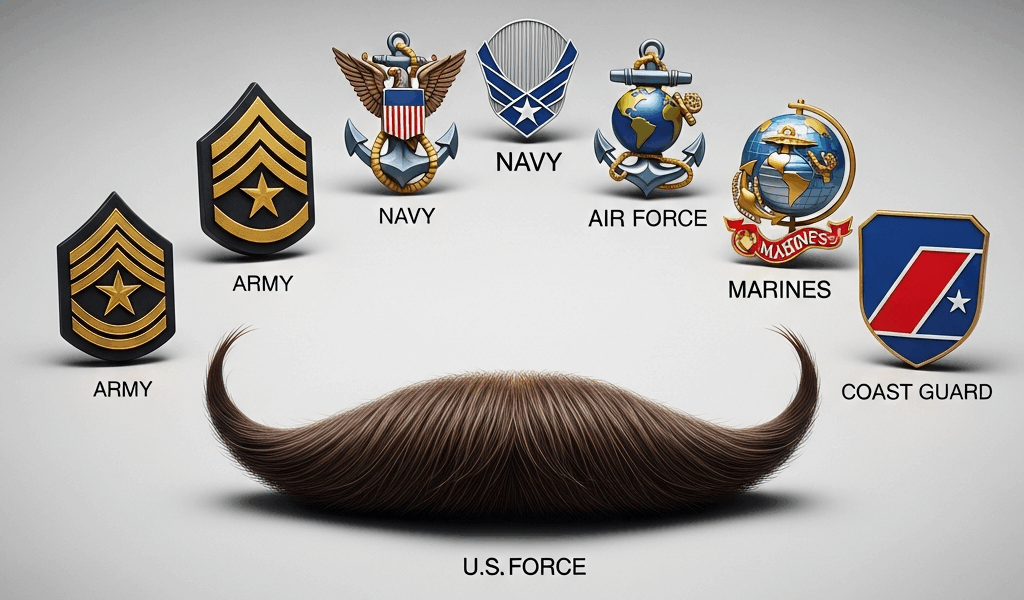
Military Mustache Regulations — Every Branch Compared
Military mustache regulations are, without exaggeration, one of the most searched and least clearly answered topics in the grooming space. I spent a decade in uniform and probably violated at least two of these rules before I actually read the relevant Army regulation cover to cover. The rules exist. They’re specific. And they differ — sometimes significantly — depending on which branch you serve or are thinking about joining. What nobody has done, until now, is put all six branches side by side so you can actually compare them without bouncing between six different PDFs from six different .mil websites.
That’s exactly what this article does.
Mustache Rules by Branch — Side by Side Table
Every branch of the U.S. military permits mustaches. Full stop. None of them ban facial hair outright for men in standard duty assignments, though all of them impose restrictions on what that mustache can look like. The restrictions cluster around three variables: length, width, and style. Here’s the full breakdown.
| Branch | Length Limit | Width Limit | Style Restrictions | Governing Regulation |
|---|---|---|---|---|
| Army | Cannot extend below the lip line | Cannot extend beyond the corners of the mouth | Must be neat and trimmed; no handlebar, no forks | AR 670-1 |
| Air Force | Cannot extend below the lip line | Cannot extend beyond the corners of the mouth | Neat and conservative; no eccentric styles | AFI 36-2903 |
| Navy | Cannot cover the upper lip; full beard permitted separately | No explicit width limit specified | Neatly trimmed; connects to beard if worn | MILPERSMAN 1000-020 / NAVADMIN 025/19 |
| Marine Corps | Cannot extend below the lip line | Cannot extend beyond the corners of the mouth | Neatly trimmed; no flamboyant or eccentric styles | MCO P1020.34 |
| Coast Guard | Cannot extend below lip line | Cannot extend beyond corners of the mouth | Neat and trimmed; full beards permitted with command approval | CG-1020 |
| Space Force | Cannot extend below lip line | Cannot extend beyond corners of the mouth | Mirrors Air Force standards closely; neat and conservative | DAFMAN 36-2903 |
The Navy stands out immediately. They’re the most permissive — they’ve allowed full beards since 2019, and a mustache worn in isolation follows the same general “don’t cover the upper lip” standard without the rigid width cap you see everywhere else. The Marines, as you’d expect, are the strictest in tone if not in exact measurement. Their regulation language uses the phrase “flamboyant” specifically, which is a word choice that tells you everything about the culture.
Space Force largely inherited Air Force grooming standards when it stood up in 2019 and has maintained them through DAFMAN 36-2903, which replaced the old AFI numbering. If you’re a Guardian and your mustache would pass muster in the Air Force, you’re fine.
What Counts as Neat and Trimmed
Here’s where people get tripped up. The phrase “neat and trimmed” appears in every single branch’s regulation, and it sounds clear until you’re standing in front of a mirror trying to figure out if your chevron-style lip warmer is going to get you counseled.
Let’s be precise. Across all branches, a compliant mustache must:
- Not extend below the upper lip line — this means the hair cannot droop over or cover the actual line where lip meets skin
- Not extend beyond the natural corners of the mouth — measured at rest, not when you’re smiling
- Appear intentional and maintained — scraggly growth, uneven edges, or visible patchiness will draw attention from an NCO or officer who wants to find a problem
What’s explicitly prohibited across most branches:
- Handlebar mustaches — the curled or waxed ends that extend outward past the corners of the mouth are out in the Army and Air Force specifically
- Fu Manchu style — long downward extensions are banned everywhere
- Anything that connects to a chin strip or goatee — in branches that don’t permit beards, a mustache must be a standalone feature; it cannot connect down the sides of the mouth to form a horseshoe or connect across the chin
- Dyed or colored mustaches — hair color must be natural-looking; applying, say, a can of Manic Panic to your stache is going to be a very short experiment
The practical measurement that matters most — and I learned this the hard way during an inspection at Fort Bragg around 2011 — is the upper lip line. Grow it too long and it naturally droops. A good pair of mustache scissors, something like the Seki Edge SS-106 or the Brow Groom by Tweezerman at around $12–$18, will handle this easily. Trim across the top first, then clean the bottom edge last. Don’t guess. Use a fine-tooth comb to hold the hair out while you cut.
Probably should have opened with this section, honestly. Half the questions people have about military mustache regulations are really just questions about this specific measurement problem.
The Famous Military Mustaches
Motivated by the history of aviation legends he’d read about as a teenager, Robin Olds grew what became arguably the most famous mustache in U.S. Air Force history. Commissioned as a fighter ace in World War II — 12 aerial kills, 107 aerial victories in all — Olds wore a handlebar mustache during Operation Bolo in 1967 while commanding the 8th Tactical Fighter Wing in Vietnam. The mustache was intentional provocation. He knew it violated regulations. He grew it precisely because Air Force brass flying desk jobs in Washington couldn’t do much about it from 8,000 miles away.
When he returned stateside, he was ordered to shave it. He did. And the mustache became legend.
The tradition of the “Brigadier General mustache” is a separate piece of lore — the claim that once you pin on your first star, you’ve earned the right to wear a regulation-bending mustache without consequence. There’s no written policy supporting this. It’s mythology. But it persists because enough senior officers have worn thick, dramatic mustaches without apparent punishment that junior enlisted personnel have noticed the pattern and drawn conclusions.
Other notable military mustaches worth mentioning:
- General Norman Schwarzkopf — wore a thick, prominent mustache throughout Desert Storm; fully regulation-compliant, but substantial
- Sergeant Major of the Army William O. Wooldridge — known for an impressive dark mustache in the late 1960s, an era when Army grooming standards were somewhat more lenient
- Admiral William “Bull” Halsey — periodically photographed with full beards during extended Pacific deployments, a tradition the Navy has formally re-embraced in modern policy
Mustache March — History and Tradition
Every March, a significant portion of the United States Air Force grows a mustache. This is not a coincidence. Mustache March is a real, informal, beloved tradition in the Air Force specifically — and it traces directly back to Robin Olds.
The tradition began gaining traction in the late 1990s and early 2000s at various Air Force installations, though its origins are genuinely grassroots and hard to pin to a single date. The premise is straightforward: airmen grow mustaches throughout March in honor of Olds and the fighter pilot culture he embodied. Some units make it competitive. Commanders who would normally enforce grooming standards to the letter often look the other way — not officially, but practically.
By the 2010s, Mustache March had spread beyond individual bases into Air Force culture broadly. The Air Force Times covered it. Charitable components emerged — some squadrons tie Mustache March participation to fundraising for veterans’ organizations or wounded warrior charities. The Olds Foundation, named for Robin Olds and focused on mentoring military youth, has been associated with the tradition in various years.
What makes Mustache March interesting from a regulatory standpoint is that it exists entirely in a gray zone. AFI 36-2903 doesn’t carve out an exception for March. A commander who wanted to enforce standards during Mustache March legally could. The tradition survives entirely on command culture, unit cohesion, and the general understanding that a handlebar mustache worn in February is a problem, but the same mustache worn in March by a fighter pilot honoring Robin Olds is something closer to heritage.
The Space Force, which shares its regulatory framework with the Air Force, has largely inherited Mustache March as well. Guardians at Peterson Space Force Base and Schriever Space Force Base have been spotted participating. Whether the tradition fully transplants to a branch that’s still building its identity is an open question — but the early signs suggest yes.
If you’re active duty Air Force or Space Force and you want to participate, the practical advice is simple: start growing on March 1st, tell your supervisor what you’re doing and why, and shave by April 1st. In units with strong Mustache March culture, you’ll get more grief for not participating than for growing something spectacular.
The mustache, in military context, is never just facial hair. It carries rank, history, attitude, and in some cases genuine regulatory risk. Know your branch’s specific rules, keep it trimmed, and if it’s March — grow accordingly.

Leave a Reply