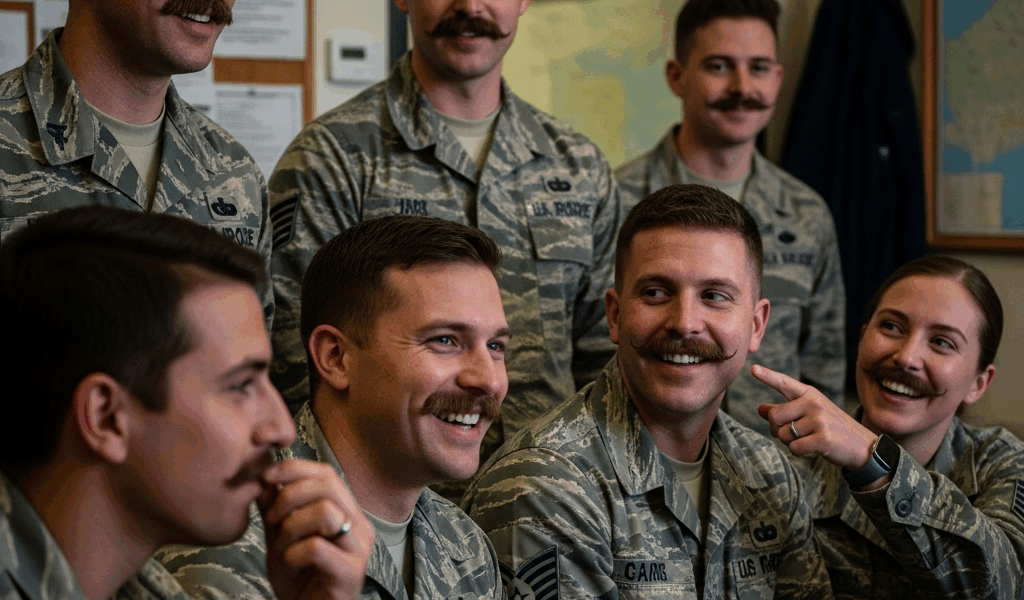
Mustache March — The Air Force Tradition Explained
Mustache March in the Air Force is one of those traditions that sounds like a joke until you learn where it actually came from. Then it sounds like exactly what it is — a piece of living history worn on the faces of airmen every spring, a tribute to one of the most decorated and genuinely fearless fighter pilots America ever produced. I’ve spent a lot of time around Air Force culture, and I’ll tell you this: few traditions carry the kind of backstory that Mustache March does. Most people know the name Robin Olds. Far fewer know the full story of why his mustache matters.
Robin Olds and the Mustache That Started It All
Brigadier General Robin Olds was not a subtle man. He flew 107 combat missions in World War II, shot down 12 German aircraft, and then — because apparently one war wasn’t enough — came back for Vietnam, where he added four more aerial kills to his total and became one of the most celebrated fighter pilots of the 20th century. He’s one of only a handful of American pilots to achieve ace status in two separate wars. That alone makes him legendary.
But the mustache. That’s where the story gets interesting.
During his command of the 8th Tactical Fighter Wing at Ubon Royal Thai Air Force Base in 1967, Olds grew a mustache that could only be described as aggressively magnificent — a thick, drooping, handlebar-adjacent piece of facial architecture that violated Air Force grooming regulations pretty much by design. He wore it through Operation Bolo, the January 1967 mission he personally planned and executed, which tricked North Vietnamese MiG-21 pilots into an ambush by disguising F-4 Phantoms as slower F-105s. Seven MiGs downed in one engagement. It was one of the most tactically brilliant air operations of the entire war.
When Olds returned stateside, the Air Force had opinions about his face. Specifically, about the part of his face that had grown well past regulation length. The story — and this is the part that gets repeated at every O-Club worth its salt — is that the Air Force ordered him to shave it. And he did. But not before making absolutely sure the order was on the record.
His reported response to the situation was something along the lines of: the mustache was the only thing he owned that the Air Force couldn’t take from him. Different versions of the quote circulate, but the sentiment is consistent. The mustache was defiance made visible. It was a statement that even inside a rigid institutional structure, there’s still a human being in the flight suit.
Inspired by Olds, airmen began growing mustaches in March — his birth month — as a tribute. That’s the origin. Not a policy. Not a memo. A gesture of respect toward a man who flew into combat and came back with a mustache that told the story before he could.
How Mustache March Became Tradition
The formal or semi-formal observance of Mustache March as a wing-wide or base-wide event is harder to pin to a single date than the Robin Olds connection. Traditions like this don’t get founded at a ceremony with a plaque. They spread the way most good Air Force culture spreads — through squadrons, through TDYs, through guys who heard the story at one base and brought it to the next one.
By the 2000s, Mustache March was showing up consistently across active duty wings, Guard units, and Reserve squadrons. Some units treat it as a full competition — there are categories. Best overall, best handlebar, most creative, most regulation-defying within still being technically legal. Others keep it low-key, more of an individual choice than an organized event. The variation is part of what makes it genuine. Nobody’s enforcing participation. That would kind of miss the point.
Unit commanders have different relationships with the tradition. Some lean in hard — a squadron commander growing his own mustache signals to the troops that the culture is healthy and that leadership has a sense of humor about itself. Others treat it as a background event, tolerated rather than celebrated. The wings that go all in tend to have more fun in March. That’s an observation, not a judgment.
Probably should have opened with this section, honestly — because understanding that this tradition is entirely grassroots makes the Robin Olds story hit differently. Nobody mandated this. Airmen chose it, year after year, unit after unit, because the story of a triple ace with a rule-breaking mustache resonated. That’s a cultural transmission worth paying attention to.
The tradition has also jumped service branches to some degree. You’ll find Navy and Marine aviators who participate, particularly those who fly alongside Air Force units in combined operations. The mustache doesn’t care about your branch patch.
The Rules of Mustache March
Here’s where people get themselves in trouble. Mustache March is not a grooming regulation holiday. The Air Force doesn’t suspend AFI 36-2903 — the dress and personal appearance standards — for the month of March. What the tradition does is give airmen a reason to grow a mustache within the boundaries that already exist. Those boundaries are more specific than most people realize.
Under current Air Force appearance standards, a mustache must be neat and conservative. It cannot extend below the lip line — meaning the mustache cannot cover the upper lip itself. It cannot extend beyond the corners of the mouth horizontally. No part of the mustache can be more than one-quarter inch in bulk — that’s the thickness measurement, not the length of the individual hairs but how far the mustache extends outward from the face. A big bushy handlebar that extends past the corners of the mouth is out of regulation. A thick, full mustache that stays within those corner-of-the-mouth boundaries is completely legal.
The mistake I’ve seen — and heard about more than once — is airmen treating Mustache March like a free pass and then getting counseled in week three because they grew something that belonged on a 19th-century cavalry officer. The tradition works best when people understand what they’re actually allowed to grow and then grow the best possible version of that thing. Precision within constraint. Which, come to think of it, describes a lot of what makes a good fighter pilot.
A few practical notes. Start early. Growing a mustache takes longer than most men expect to get it looking intentional rather than accidental. By day five of March, a lot of guys look like they forgot to shave one specific area rather than making a deliberate choice. Give it time. The mustache needs to commit before you do.
Commanders retain the authority to counsel or direct grooming corrections regardless of tradition. Mustache March is cultural, not regulatory. Keep that distinction clear.
Famous Military Mustaches Through History
Robin Olds doesn’t stand alone in military mustache history. Not even close.
General John “Black Jack” Pershing — commander of American forces in World War I — wore one of the most photographed mustaches in military history. Clean, disciplined, trimmed to absolute precision. It matched his command style. Pershing’s mustache looked like it had been briefed on the operational plan and agreed to comply.
On the opposite end of the spectrum, General George Armstrong Custer wore a look that included flowing hair and a mustache that seemed to be attempting to become part of his beard. Regulations were more flexible in the 1860s and 1870s. Custer took full advantage.
Arthur “Bomber” Harris, the controversial British RAF Marshal who commanded the strategic bombing campaign over Germany in World War II, had a mustache that was — and this is purely a visual assessment — doing a lot of work for his overall authoritative presence. British military culture through World War II was considerably more permissive about facial hair than the American services have ever been.
Captured by history rather than by his own design, Jimmy Doolittle — of the Doolittle Raid, the April 1942 low-level B-25 attack launched from the carrier USS Hornet against Tokyo — occasionally wore a modest mustache in earlier career photos. The image of the Raid itself is clean-shaven, all business. But the man had range.
What connects these men, and what connects them to Robin Olds, isn’t just facial hair. It’s the idea that a person operating inside a military institution remains a specific individual. The mustache, especially when it pushes against the edges of what’s allowed, says something about that. It says: I know the rules. I’m working within them. And I’m still here.
Mustache March, at its core, is the Air Force saying the same thing back to the memory of Robin Olds every year in March. We remember. We know the rules. And we’re still here.



Leave a Reply