Military Tattoo Policy 2026 — What Every Branch Actually Allows Now
Military tattoo policy in 2026 has gotten complicated with all the misinformation flying around. As someone who spent three years digging through grooming standards, regulation updates, and MEPS horror stories across every service branch, I learned everything there is to know about this subject. Today, I will share it all with you.
People show up to MEPS convinced a small forearm piece will end their military career before it starts. Others get stationed overseas thinking their sleeve is fine — then discover their command reads the rules differently. I’ve talked to staff sergeants, petty officers, Marine recruiters, and one very stressed-out guy with a Celtic cross on his arm. The rules are actually clearer than you’d think. What gets mangled is the practical translation.
So, without further ado, let’s dive in.
Army Tattoo Rules — Unlimited Below Elbows and Knees
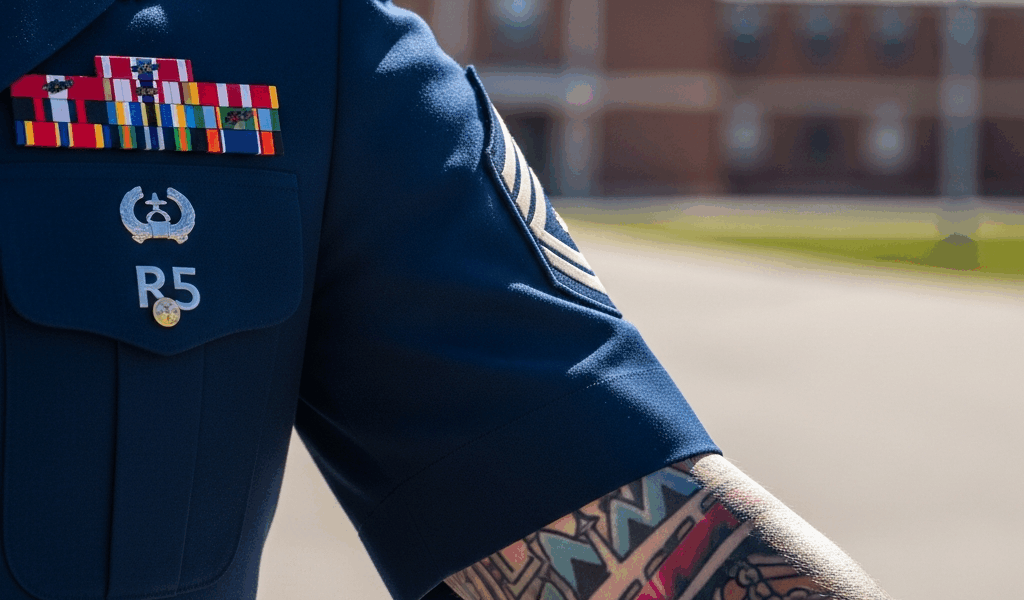
The Army’s 2023 update was the most permissive shift across the entire DoD. Soldiers got essentially unlimited coverage below the elbows and knees — no size caps, no quantity limits. Full sleeves on both arms. Both legs. Chest, back, whatever. Provided it clears content standards, you’re fine.
Here’s what actually matters: placement categories.
- Fully Authorized Areas — forearms, hands (except palms), upper arms, legs below the knee, torso, back. No limits on number, size, or density.
- Neck and Hand Tattoos — one per hand allowed. One neck tattoo. These stay smaller and less visible in dress uniform. One inch is generally the safe ceiling.
- Permanently Banned — face, head above the hairline, throat, inside the mouth, eyelids, palms, soles of feet.
One staff sergeant I spoke with had been turned away from a recruiting station in 2019 over visible hand tattoos. Five years later, he watched junior enlisted soldiers sign contracts with full sleeves. The Army recognized it was hemorrhaging talent over what amounted to outdated aesthetic preferences. That’s what makes the 2023 shift significant to the people who actually lived through the old rules.
Content restrictions haven’t loosened, though. Extremist symbols, gang affiliations, racist imagery, sexist content — those disqualify you regardless of placement. A perfectly positioned sleeve with white supremacist iconography gets you sent home from basic. The Army cares about your ideology, not whether your arms look like a coloring book.
One thing that surprises people — tattoos acquired while serving still need some degree of oversight. Your company commander has discretion on whether to request documentation that a piece was applied by a licensed artist, particularly if it’s visible in PT gear. This doesn’t mean you need written permission before every Saturday shop visit. But if you come back from a long weekend with something questionable, your unit will probably ask questions.
Navy, Marines, Air Force, and Coast Guard — Side by Side
The Navy and Air Force relaxed their policies around the same timeframe as the Army. Marine Corps guidelines remain tighter for officers. Assume consistency across branches and you’ll be wrong — sometimes expensively wrong.
Navy
The Navy permits sleeve tattoos on both arms. Multiple neck tattoos are allowed — up to two, roughly one inch diameter each. Hand tattoos are fine if they’re on the back of the hand and don’t exceed one inch. Wrists and forearms are wide open.
That said, the Navy measures neck tattoos more strictly than other branches. A captain I interviewed described having to clarify policy after a junior petty officer showed up with a 1.5-inch neck piece he genuinely believed was compliant. The official Navy guidance says neck tattoos must not be visible when wearing dress uniform with the collar up. One inch is the benchmark. Don’t push it.
Marines
Marines draw a hard line between enlisted and officers. Enlisted Marines can have tattoos essentially anywhere except the head, neck, and face. Officers operate under stricter rules — a maximum of four visible tattoos when wearing physical training gear. Officers can still carry substantial ink, but anything visible above the T-shirt collar or on the arms gets counted toward that four.
The rationale isn’t arbitrary. Marine recruiters I’ve spoken with describe it as a philosophy rooted in leadership presence — the cultural gap between enlisted culture and the officer corps is real and intentional. If you’re planning to commission, the four-visible rule shapes your ink strategy from day one. Probably should have opened with that caveat, honestly.
Air Force
The Air Force removed size restrictions across most areas during their 2021 revision. Forearms, upper arms, legs, chest, back — all open. What the Air Force actually weighs is professionalism of placement and execution. A large, well-done piece on a prominent location won’t raise eyebrows. A poorly executed piece in the same spot might — which is different from every other branch’s approach.
Neck and hand tattoos follow the familiar pattern: one small tattoo per hand, one on the neck, both staying relatively small and out of sight in dress uniform. The Air Force’s unofficial benchmark is “would this look professional in a staff photo.” Not square inches — overall impression.
Coast Guard
The Coast Guard updated their hand tattoo policy in 2025 — the most recent change among all branches. They went from a previous prohibition to allowing one tattoo per hand, up to 2.5 inches in length. That brought them closer to Navy standards. The rest mirrors broader DoD direction: no face or head tattoos, content restrictions enforced, everything below the elbows and knees open for business.
Comparison at a Glance
Probably should have opened with a comparison table, honestly, but here’s the practical breakdown:
- Unlimited arm/leg sleeves — Army, Navy, Air Force, Coast Guard. Marines allow for enlisted; officers limited to four visible.
- Hand tattoos — Army: two maximum. Navy: one per hand, back of hand only, under one inch. Air Force: one per hand, small. Marines: general rules apply for enlisted, multiple allowed. Coast Guard: one per hand, up to 2.5 inches.
- Neck tattoos — Army: one maximum, small. Navy: up to two, small. Air Force: one, small. Marines: not permitted for officers; enlisted follow general rules. Coast Guard: follows general neck guidelines.
- Face/head — All branches: permanent ban, no exceptions.
The head restriction matters because “head” gets defined differently depending on who’s reading the regulation. The Navy specifically says “above the hairline” — which means a tattoo behind the ear or low on the back of the neck might technically clear the rule, depending on your command’s interpretation. The safest approach: if it appears on your head in a photograph, stay away from it.
What Will Get You Disqualified
Content restrictions cut across every single branch uniformly. This is where MEPS gets specific — and where people get surprised.
Disqualifying content includes:
- Extremist symbols and ideology — white supremacist tattoos, Nazi imagery, anything associated with hate movements
- Gang-related markings or text
- Racist, sexist, or derogatory content targeting any group
- Depictions of illegal activity framed positively or aspirationally
- Terrorist organization affiliations or support
- Anarchist or anti-government symbolism — this one’s fuzzy, but MEPS errs conservative
What doesn’t automatically disqualify you: religious imagery, non-extremist political symbols, profanity that isn’t directed at a group, band references, edgy artwork, memorial tattoos. One recruit I spoke with had a Friedrich Nietzsche quote tattooed in German across his shoulder blade — full gothic lettering, roughly eight inches wide. MEPS didn’t care. He enlisted without incident.
The medical personnel reviewing your tattoos at MEPS aren’t art critics. They’re checking a list. A swastika — regardless of whether you claim it’s a Buddhist symbol — will flag you. Don’t make my mistake of assuming context automatically saves you. It might. It might not. The conversation could last twenty minutes and feel genuinely uncertain, even if you have a legitimate explanation.
I interviewed a guy with a Celtic cross on his arm — a legitimate religious symbol also used by extremist groups. MEPS asked him about it. He explained his family’s Irish heritage. That was sufficient. But he said the conversation was uncomfortable, and for a moment the outcome wasn’t clear.
The lesson: if any tattoo could plausibly read as extremist, gang-related, or offensive, document your explanation before you walk into MEPS. Bring photos of the original design reference if you have them. Recruiters have seen everything, and context genuinely matters — but you need to bring that context with you.
Getting a Tattoo While Serving — What to Know
This section is for people already signed and thinking about new ink.
The baseline is simple: branch policy still applies — and so does your command’s supplemental guidance, if they’ve issued any. The overall DoD policy might clear you. Your captain might not. Who wins? Your captain. That’s not a bureaucratic technicality. That’s how the military actually functions.
I’m apparently someone who over-researches this stuff, and talking to three active-duty sailors confirmed what I suspected: command approval isn’t always formally required, but command awareness is. One petty officer got a large calf tattoo during a port visit — fully regulation-compliant — and didn’t mention it to anyone. When PT gear changed seasonally and the piece became visible, his chain of command questioned when and where he’d gotten it. No policy violation. Real friction anyway.
Best practice: tell your first-line supervisor before you book the appointment. Don’t ask permission if your branch policy allows it — but communicate the plan. Show the design. Confirm placement is compliant. This costs you nothing and demonstrates exactly the kind of military bearing that keeps your career moving forward.
If you’re getting tattooed on leave, use a licensed shop. Not a friend with a machine. Not a guy in the barracks. A licensed facility. Keep the shop’s name, address, and license number — some service members photograph their healed work with that information stored digitally alongside it. Sounds paranoid. It’s actually smart.
One other thing worth mentioning: no policy differentiates between color work and black and gray. But some commands carry a cultural preference for black and gray in dress uniform environments — purely aesthetic, not regulatory. A large, vivid color piece visible in dress blues might attract scrutiny that an equally sized black and gray piece wouldn’t. Don’t let that stop you from getting what you want. Just know the environment you’re operating in.
The Practical Reality — What You Actually Need to Do Right Now
If you’re enlisting, read the actual regulations — not your recruiter’s summary of them. The Army’s policy lives in AR 670-1. Air Force standards are in AFI 36-2903. Navy publishes NAVADMIN messages. Coast Guard and Marine Corps have their own equivalents. Recruiters are good people doing a demanding job. They are not tattoo policy specialists. Don’t outsource that research to them.
If you’re already serving and want new ink, verify three things before you book: first, check your branch’s current official regulation. Second, confirm your command hasn’t issued supplemental guidance — your S-1 or personnel office can tell you in about five minutes. Third, talk to your first-line supervisor. That’s the whole checklist. You’re compliant and you’ve communicated.
If you have existing tattoos and you’re worried, address it early — before you enlist, or as soon as you identify a potential problem while serving. MEPS disqualifications over tattoo content are genuinely rare when the imagery is clean. Command friction happens, but it resolves through conversation far more often than it escalates.
Military tattoo policy in 2026 is permissive by any historical standard. The branches want your skills. They want your commitment. They are not trying to reject you over arm sleeves. Know the rules, follow the rules, communicate with your chain of command. Everything else sorts itself out.



Leave a Reply