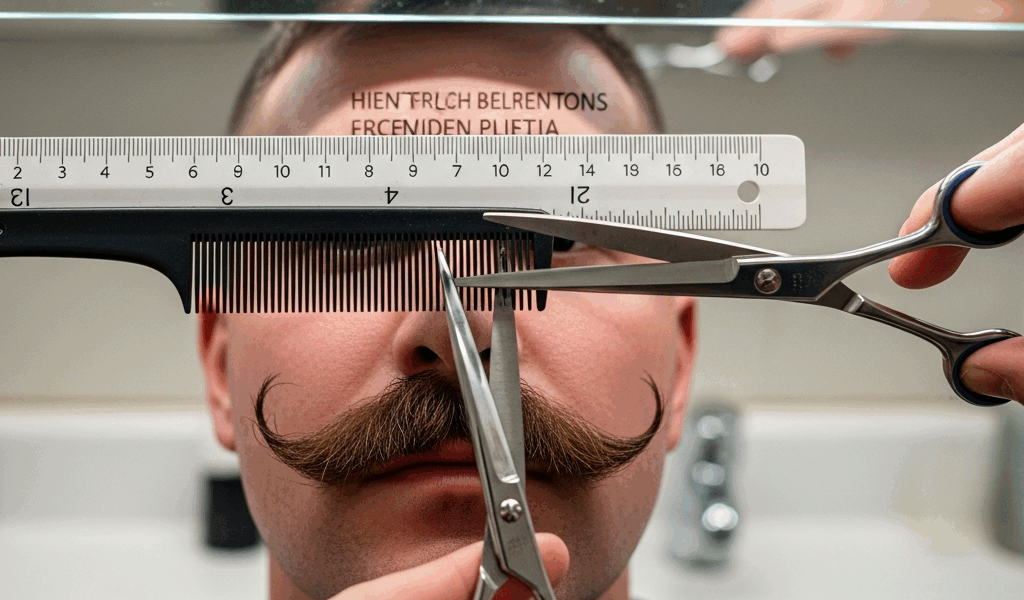
The Two Rules Every Branch Agrees On
Military mustache grooming has gotten complicated with all the conflicting advice flying around. But strip it down and every branch — Army, Navy, Air Force, Marines, Coast Guard — actually agrees on two non-negotiable rules. Everything else is branch-specific noise.
Rule one: it cannot drop below your upper lip line. The moment that hair grazes your actual lip, you’re out of regs. Full stop. Rule two: width ends at your mouth corners. That’s it. Two invisible lines. Stay inside them and you’re good. Drift outside either one and you’re having an uncomfortable conversation with your CO before formation even starts.
Branches get opinionated about density and exactly how close to the lip is acceptable — but those two rules? Universal. I won’t rehash the full branch-by-branch breakdown here since this article is specifically about the trim itself. That’s a separate guide worth reading on its own.
Tools You Actually Need Before You Start
Probably should have opened with this section, honestly. Most guys grab whatever’s already sitting on the bathroom shelf and wonder why the result looks off. A 4mm beard guard will leave your mustache looking like a decorative hedge. That’s not the goal.
- Precision trimmer with a 1–2mm guard. The Wahl Detailer — around $30 to $45 at most grooming stores — gives you actual control over what you’re cutting. I’m apparently a cordless trimmer person and the Detailer works for me while my old full-size beard trimmer never gave me clean enough edges. The guard difference sounds minor. It isn’t.
- Fine-tooth mustache comb. A 3-inch metal comb, something like the Hawkins & Hill or Kent models in the $8–15 range, combs the hair flat so you can actually see your lip line underneath. Trimming without one is trimming blind. Don’t make my mistake.
- Sharp grooming scissors for detail work. Not craft scissors — those dull fast and shred the hair instead of cutting it. Tweezerman makes a solid pair for around $20. Shredded ends look worse than hair that’s slightly too long. Clean cuts only.
- Bright mirror under real light. Your bathroom mirror at 6 a.m. is not enough. A magnifying mirror under LED lighting is the difference between catching a rogue long hair before inspection and having someone else point it out during it.
That’s what makes this setup endearing to us — it’s four things. No beard oil, no growth serums, no specialty soap. That stuff comes later, after the trim itself is dialed in.
Step-by-Step Trim That Keeps You In Regs
Step 1: Trim completely dry.
Wet hair lies longer than it actually is. Dry, it shrinks — sometimes 10 to 15 percent depending on your texture. Trim it wet and you’re cutting shorter than you realize. Twenty minutes later it’s dried down and you’re looking at something that resembles a thin pencil line. Comb it through, wait the extra minute, then start.
Step 2: Comb straight down and find your natural lip line.
Drag the comb downward, perpendicular to your face. This flattens everything and reveals the lip line underneath — your actual hard boundary. Look at it. Remember it. Most guys skip this and eyeball it instead, which is exactly where the errors start. You need to see the line before you cut near it.
Step 3: Run the precision trimmer horizontally across the bottom edge, staying 1–2mm above the lip line.
Light pressure. Let the trimmer work. Start at center and move outward toward each corner. Digging in creates thin patches — ask me how I know. Keep the trimmer flat and parallel to your mouth. Angle it even slightly and you’re cutting uneven lines that’ll catch light during inspection.
Step 4: Handle the corners with scissors, not the trimmer.
Corner hair grows outward and downward simultaneously — it’s the high-anxiety part of every trim. Hold the comb vertical along the corner as a guide and snip anything extending past your mouth corners. One deliberate cut beats three trimmer passes every time. The trimmer is imprecise here. Scissors aren’t.
Step 5: Taper the sides with scissors to keep it from looking like a block.
Hold the comb at a 45-degree angle along each side and trim anything that extends past it. This takes maybe three minutes. It’s the difference between a mustache that reads as “maintained” versus one that reads as “intentional.” Those are two different things. One gets you through inspection. The other earns a nod.
Common Mistakes That Get You Flagged
Mistake 1: Trimming wet hair. You’re already in the shower, it seems efficient. Then it dries and it’s sitting 5mm shorter than you planned. Trim dry — always. If you’re in a rush, comb it through and wait until evening. It’s not worth the reset.
Mistake 2: Using a full-beard guard. A 4–6mm guard is fine for jaw stubble. On a mustache, it creates a dense block that reads as sloppy rather than sharp. You need the 1–2mm guard, period. One guard size is the difference between passing and explaining yourself.
Mistake 3: Ignoring corner growth between trims. Those hairs grow faster than everything else — you’ll notice them in the mirror every single day. The mistake is letting them accumulate until the morning of formation, then panic-cutting too much off. Check the corners every three days. Ten seconds. One snip. Done.
Mistake 4: Uneven lip line left to right. Faces aren’t symmetrical and neither is mustache growth. Trimming one side a millimeter higher than the other is the fastest way to look careless. Use the comb as a straight edge, step back, and compare both sides before you call it finished.
How Often Should You Trim It
Fast growers need a full trim every five to seven days. Slower growth, every ten days is workable. The frequency isn’t really about hitting some perfect length — it’s about looking intentional. A slightly overgrown mustache reads as neglected. The same mustache trimmed consistently reads as discipline. That distinction matters in uniform.
Inspect the day before any formation or official inspection. Not that morning — the day before. That buffer gives you time to fix something if it’s off, rather than scrambling at 0600 with a trimmer in one hand and no light in the other. That’s when bad trims happen. So, without further ado, build the night-before check into the routine and keep it there.




Leave a Reply