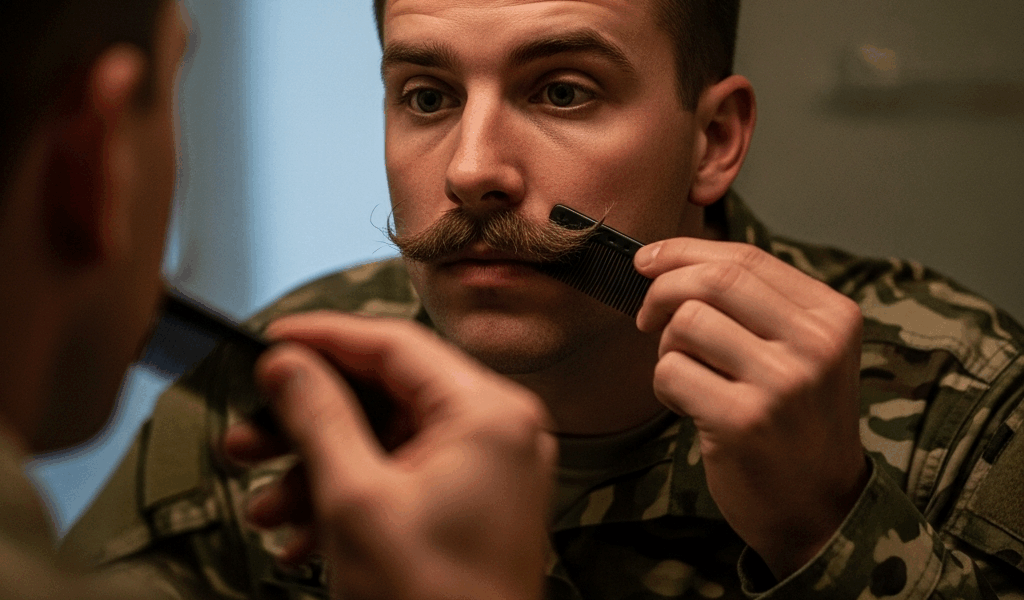
Why Your Military Mustache Looks Uneven in the First Place
Military mustache grooming has gotten complicated with all the conflicting advice flying around. As someone who spent the better part of a decade in uniform, I learned everything there is to know about keeping facial hair regulation-compliant. Today, I will share it all with you.
The short answer? Your face isn’t symmetrical, your trimming hand is working against you, and you’re measuring against the wrong thing entirely. I chased asymmetry around my own upper lip for a solid month before I figured out why — trimming carefully, or so I thought, while the problem just kept moving.
First culprit: uneven growth rates. The left and right sides of your upper lip don’t grow at the same pace. One side comes in faster and thicker — always. Genetics, blood flow, sun exposure on your dominant side. You won’t notice it during the grow-out phase. The second you start trimming, though, one side is visibly longer. Every time.
Second culprit: your dominant hand. Right-handed? You trim the right side fractionally shorter because that’s your control side. Left-handed? Same issue, mirrored. It’s not sloppiness. It’s precision working against you — your strong hand is too consistent, and that consistency compounds into visible asymmetry over a few sessions.
Third culprit: the mirror centerline. It feels like a reliable anchor. It isn’t. Your pupils drift. Your head tilts a degree or two without you registering it. Bathroom lighting shifts angle based on exactly where you’re standing. None of that is stable. Your mustache doesn’t care about mirror geometry — it sits on actual anatomy, and that’s what you need to measure against.
The Reference Points That Actually Matter for Regulation Mustaches
Probably should have opened with this section, honestly. This is the real problem — not the tools, not the technique. The reference point.
But what is a proper reference point? In essence, it’s a fixed anatomical landmark you can measure against consistently. But it’s much more than that — it’s the difference between passing inspection and getting flagged on a Tuesday morning.
Stop using the mirror centerline. Use your mouth instead.
Your mouth corners and the edge of your upper lip are anatomically fixed. They don’t drift. The corners sit at the same height on both sides — that’s skeletal structure, not opinion. The upper lip edge is the hard horizontal boundary between your skin and your hair. These two points don’t lie to you the way a mirror does.
Here’s what most guys do instead: they eyeball the overall shape, decide it looks balanced, and walk away. The eye drifts. The trimming hand has its bias. The head tilts. That’s what makes consistent measurement endearing to us regulation-conscious folks — it removes every variable the eye introduces.
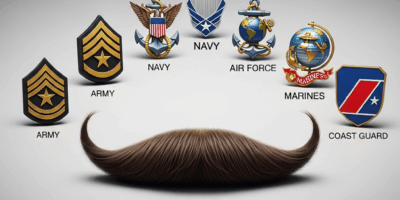
Why does this matter for your specific branch? Army regulations cap the mustache at no more than one-quarter inch beyond the corners of the mouth. Air Force tightens that to one-eighth inch on each side of the mouth centerline. Marine Corps specifies one-quarter inch maximum length, neatly trimmed and waxed. Every single standard anchors to those mouth corners or the centerline of the mouth itself. Guessing against a mirror will get you flagged. So, without further ado, let’s dive in.
Step-by-Step Fix for an Uneven Military Mustache
- Comb down dry with a fine-tooth comb. Wet hair flattens and hides actual length — don’t trim right after a shower. Dry hair shows you exactly what you’re working with. A Kent 81T mustache comb runs about $12 to $15 and the tooth spacing is tight enough to catch every hair without dragging. Comb straight down from center outward on both sides. Takes thirty seconds. It’s also the step most guys skip entirely. Don’t make my mistake.
- Identify the longer side by looking, not feeling. Fingers don’t measure — they sense pressure. Your eyes, aimed at the comb, can actually show you which side extends past the teeth further. Mark it mentally. That’s the only side getting cut right now.
- Set your trim boundary at the mouth corners. Army and Marine Corps: the outer edge of your mustache stops at the corner of your mouth — full stop. Air Force: one-eighth inch inward from that corner. Know your branch standard before the trimmer turns on. Your pinky finger works as a rough tactile spacer if you need one, but the corner of your mouth is the hard limit.
- Trim the longer side in small passes only. A detail trimmer with a guard is what you want here — a Wahl Peanut with the 0.5mm guard runs around $40 to $45 and the small head gives you real edge control. One pass, then check. Another pass, then check again. You’re removing maybe two or three hairs at a time. That sounds tedious. It is. It’s also the only method that doesn’t overshoot.
- Never trim both sides simultaneously when correcting asymmetry. This is the vicious cycle. You trim “just a touch” from both sides, one comes out slightly longer, you trim both again, and suddenly you’re approaching the regulation minimum with the problem unsolved. Touch only the long side until it matches.
- Check symmetry against the lip corners — not the mirror centerline. After every pass, look at the distance between your mustache edge and the corner of your mouth on each side. Same distance? That’s symmetry. The centerline in the mirror will lie to you based on how your head is angled. The corners of your mouth won’t.
- Run a final regulation width check. Comb it down one more time. Measure your branch standard — one-quarter inch maximum beyond the corners for Army and Marine Corps, one-eighth inch from centerline per side for Air Force. If you’re inside the limit and symmetrical, you’re finished. If you’re right at the edge and still slightly off, regulation compliance beats cosmetic perfection every time.
Tools That Make a Difference and Ones to Skip
- Fine-tooth mustache comb (Kent 81T, around $12–$15): Non-negotiable. Shows true hair length without distortion or pulling.
- Detail trimmer with adjustable guard (Wahl Peanut, $40–$45): The guard stops you from cutting too short in a single careless pass. The small head — about an inch wide — gives you the edge control a full-size trimmer can’t. I’m apparently a creature of habit and the Wahl works for me while every generic drugstore trimmer never quite does.
- Consistent overhead lighting: A phone flashlight bounces shadows everywhere and will cost you accuracy. A clip lamp mounted over the bathroom mirror runs about $18 to $22 at any hardware store — directional, consistent, no guessing.
Skip these: electric shavers on mustache edges — imprecise and they catch and pull hair. Eyebrow razors — built for different hair density, and they’ll leave uneven marks on coarser upper-lip hair. Trimming right after a shower — water weight compresses the hair and masks actual length until it dries and springs back longer than you cut it.
When to Start Over Instead of Keep Correcting
Three corrections for the same asymmetry inside two weeks — that’s the mustache telling you something. Once you’ve trimmed down close to the regulation minimum, one more correction pass puts you in violation. That’s the signal. Stop. Let it grow.
It’s not failure. It’s squared-away decision-making. Regulation compliance over vanity, full stop.
Expect about four weeks to get back to a length worth trimming. Plan around your inspection calendar and any unit photos — that’s not optional. Clean-shaved for six days and compliant on day seven beats fighting a too-short, still-uneven mustache for an entire month. The math isn’t complicated.


Leave a Reply