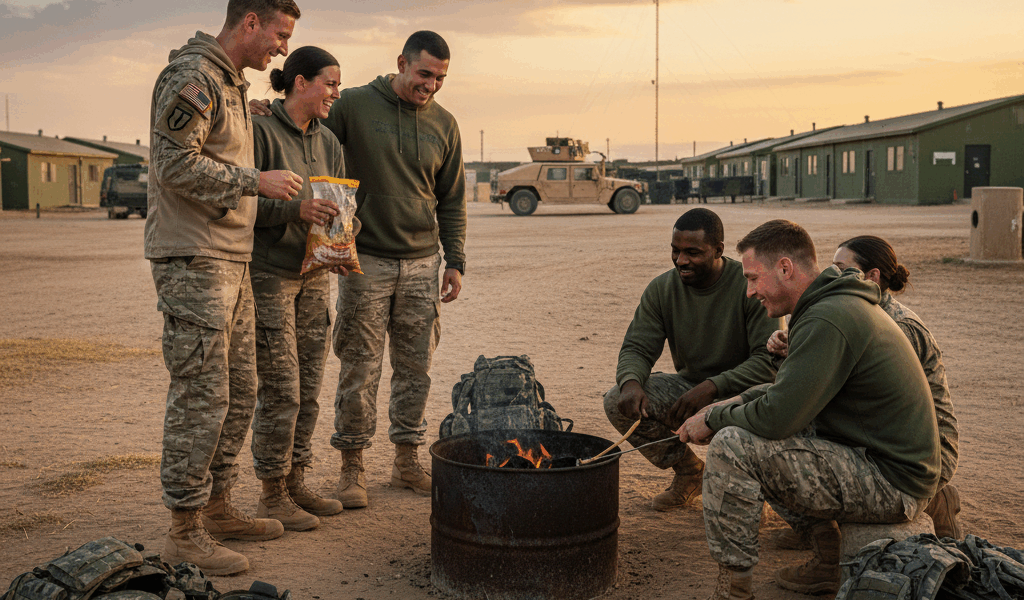
The Unwritten Rules of Military Friend Groups That Nobody Explains
Military spouse friendships have gotten complicated with all the unspoken expectations flying around. As someone who’s navigated these waters through multiple duty stations and deployments, I learned everything there is to know about surviving military social circles. Today, I will share it all with you.
You’ve found your people. You’re part of the unit spouse circle, the neighborhood text chain, the coffee group that meets every Tuesday. But there are rules here that nobody explicitly states, and violating them can make things awkward fast.
Consider this your field manual for military friendship survival.

Rule One: Rank Dynamics Exist but Must Never Be Acknowledged
Probably should have led with this section, honestly. Here’s the uncomfortable truth: rank affects spouse relationships whether anyone admits it or not. The colonel’s spouse and the private’s spouse can absolutely be friends, but there’s an invisible layer to navigate.
You don’t complain about leadership to someone whose spouse IS leadership. You don’t share information that could create awkward dinner table conversations. You learn to read the room and understand that some topics are off-limits depending on who’s present.
This isn’t about being fake. It’s about protecting everyone’s position. Your spouse has to work with these people. Creating tension in the social sphere bleeds into the professional sphere faster than you’d think. That’s what makes these dynamics tricky.
The workaround: find friends outside your spouse’s immediate chain of command. Different units, different branches, different installations if you’re near a joint base. These friendships carry less baggage. Trust me, I learned this one the hard way.
Rule Two: Deployment Information Has Layers
Some things you can share. Some things you absolutely cannot. Learning the difference takes time and mistakes.
General deployment status? Usually fine. “They’re deployed” is acceptable. Specific locations? Check with your service member first. Exact return dates? Keep those close. Movement information? Never, under any circumstances, post or share.
OPSEC exists for real reasons. But beyond official security, there’s social OPSEC too. Not everyone needs to know your coping mechanisms, your financial situation during deployment, or how close you are to losing your mind on day 87.
Find one or two trusted confidants for the real talk. The larger group gets the curated version. That’s what makes those inner circle friendships so valuable.

Rule Three: The Spouse Comparison Game Helps Nobody
Every group has the Pinterest spouse. The one whose house is always spotless, whose kids are always dressed perfectly, who somehow has time for elaborate meal prep while running a successful side business and volunteering for every FRG event.
Comparing yourself to that spouse will destroy you. Don’t do it.
What you don’t see: their support system, their personal struggles, their behind-the-scenes chaos. Everyone has a highlight reel and everyone has an unfiltered reality. Yours is valid even if it doesn’t look Instagram-worthy.
The best military friend groups lift each other up instead of competing. Find those groups. Leave the ones that make you feel inadequate. I’ve had to walk away from a few toxic circles myself, and it was always the right call.
Rule Four: The Information Network Is Powerful and Dangerous
Military spouse groups know things. Sometimes before official channels announce them. The speed at which information travels through the network would impress intelligence agencies.
Use this power responsibly. Not everything you hear is accurate. Rumors spread faster than facts. The person who “definitely knows” something often doesn’t.
Before you share what you heard, ask yourself: Is this confirmed? Could this hurt someone? Am I adding value or just spreading gossip?
The flip side: the network also provides genuine support. When someone needs meal train help, childcare in an emergency, or just someone to talk to at 2 AM, the network delivers. That’s the version worth participating in. That’s what makes this community special.
Rule Five: Some Friendships Won’t Survive the PCS
This is hard but true. Not every friendship you make is meant to last forever. Some are meant for that duty station, that season, that specific moment in your life.

When PCS separates you, some friendships will transition beautifully into long-distance versions with regular calls and reunion visits. Others will fade, not because anyone did anything wrong, but because the context that connected you no longer exists.
This doesn’t diminish what those friendships meant. It’s just the nature of this life. Let people go gracefully when it’s time. I’ve held onto some friends through a decade of moves, while others were perfect for exactly one tour.
Rule Six: The New Person Needs You
Probably should have led with this one too, honestly. Remember your first day at a new duty station? The disorientation? The loneliness? The desperate need for someone, anyone, to tell you where the good grocery store is?
Be that person for someone else. The new spouse at the FRG meeting sitting alone needs an invitation to coffee. The newcomer on the neighborhood Facebook page asking basic questions needs patient answers, not judgment.
Every military friendship starts with someone reaching out first. Make that your role. The community you want to be part of is the one you help create.
Rule Seven: Take Care of Your Own Boundaries
Military spouse culture can be intense. The expectation to be involved, supportive, constantly available can lead to burnout if you don’t set limits.
You can decline FRG leadership. You can skip the event you don’t want to attend. You can protect your time and energy without being a bad military spouse.
The friends worth having will respect your boundaries. The ones who don’t respect those boundaries are telling you something important about the friendship. That’s what makes boundary-setting so revealing.
The Bottom Line
Military friendships are simultaneously more complicated and more valuable than civilian friendships. The shared experience creates deep bonds fast. The constant turnover means relationships require intentional maintenance.
Navigate the unwritten rules, find your people, and remember: everyone in this community is figuring it out as they go. Including you.
That’s what makes us good at this. We’ve had a lot of practice.




Leave a Reply