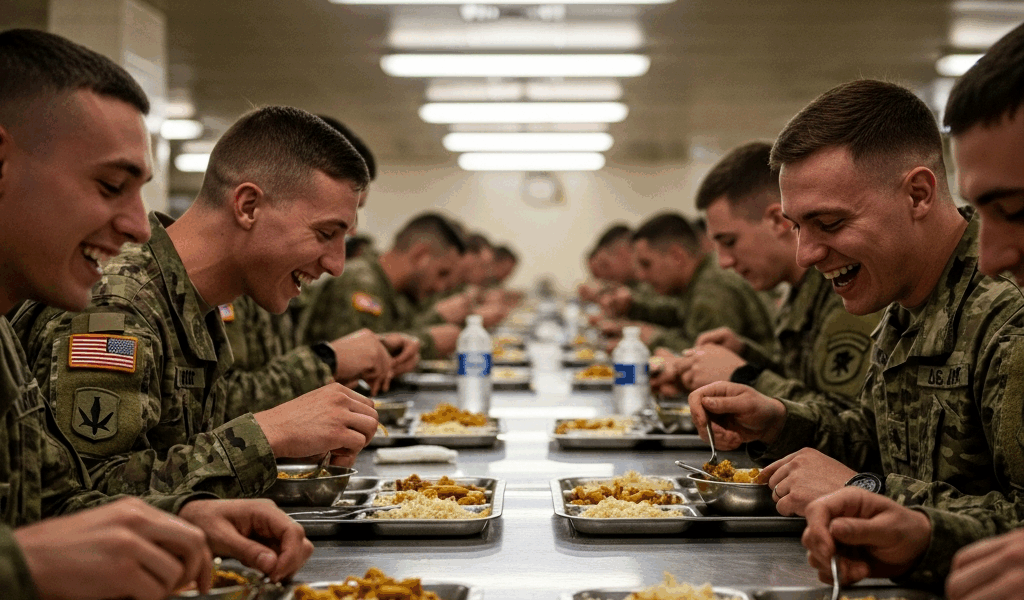
DFAC stands for dining facility. In everyday military use, it usually means an installation dining hall that serves authorized diners during scheduled meal periods. Depending on the service, location, and generation of the speaker, you may also hear dining hall, mess hall, chow hall, galley, or another local name.
A DFAC is not simply a military-themed cafeteria. It operates within a food-service program, follows installation procedures, supports service-member readiness, and may use Department of Defense performance-nutrition tools such as Go for Green. Access, payment, meal entitlements, guest rules, menus, and operating hours vary, so the local facility remains the authority for a specific visit.
What Does DFAC Mean in the Military?
The acronym is commonly pronounced “dee-fack.” It describes the facility rather than a single menu format. A large permanent installation may have several dining facilities with multiple serving lines, while a smaller site may offer a limited menu or grab-and-go service. Field feeding, flight kitchens, shipboard galleys, deployed feeding sites, and packaged operational rations are related parts of military food service but are not all interchangeable with a standard installation DFAC.
The name can also reflect service culture. “Galley” is common in naval settings. “Chow hall” and “mess hall” remain familiar informal terms. Official signs and current policy may use dining facility, dining hall, warrior restaurant, campus-style dining, or a locally branded name.
Who Can Eat at a DFAC?
Eligibility is installation- and facility-specific. Some service members receive meals through an assigned meal entitlement; others pay for meals. Access for retirees, civilian employees, contractors, family members, guests, and visitors can differ by location, meal period, mission, and local policy.
Do not assume that possession of a military ID guarantees access to every dining facility or that every authorized diner uses the same payment method. Before visiting an unfamiliar DFAC, check the installation’s official page or contact the facility for:
- current meal hours and holiday schedules;
- authorized patron categories;
- meal-card or entitlement procedures;
- guest and visitor rules;
- accepted payment methods and current prices;
- takeout, grab-and-go, or reservation availability;
- uniform, identification, and entry requirements.
These details can change faster than an article can be updated, especially during exercises, deployments, renovations, staffing changes, or severe weather.
What Food Does a Military DFAC Serve?
Menus vary, but a permanent dining facility may combine a main serving line with short-order, salad, sandwich, breakfast, beverage, dessert, or specialty stations. Rotating menus help serve large populations while balancing nutrition standards, supply, staffing, cost, and local demand.
Breakfast may include eggs, breakfast meats, oatmeal, fruit, cereal, yogurt, bread, and beverages. Lunch and dinner commonly combine an entrée, starch, vegetables, soup or salad, and drinks. Some facilities add themed meals, cultural menus, made-to-order stations, recovery items, or portable meals for duty schedules.
Availability is not uniform. A training installation feeding a large initial-entry population has different requirements from a small operational base. A deployed dining facility may depend on supply routes and force-protection requirements. A flight kitchen may emphasize meals that crews can carry to the aircraft.
How Go for Green Labels Work
Go for Green (G4G) is a Department of Defense performance-nutrition program used in military dining facilities and galleys. The Human Performance Resources by CHAMP program explains that food and beverage cards use a stoplight system:
- Green: high-performance fuel choices;
- Yellow: moderate-performance fuel choices;
- Red: lower-performance fuel choices.
Food cards can also show sodium as low, moderate, or high. The colors are a quick decision aid, not a moral judgment about a meal or a medical prescription. Individual needs change with body size, training volume, climate, recovery, health conditions, and duty demands.
HPRC’s official DFAC guidance recommends increasing Green-coded foods and building meals with nutrient-rich options. When labels are unavailable, a practical plate can combine a protein source, vegetables or fruit, an appropriate carbohydrate source, and water or another suitable beverage.
How to Build a DFAC Meal Around the Duty Day
The best meal depends on what comes next. A service member facing a long endurance event may need a different carbohydrate plan from someone on a recovery day. Heavy training, heat, cold, altitude, shift work, and limited time between events can change food and fluid needs.
Before physical training
Choose familiar foods that provide usable energy without causing gastrointestinal discomfort. Meal timing and portion size matter. An unusually heavy meal immediately before intense exercise can be a poor fit even when the ingredients are nutritious.
After demanding training
Recovery generally benefits from fluid, carbohydrate, protein, and adequate total energy. HPRC notes that some facilities offer recovery bars or grab-and-go items intended to support post-training needs.
During ordinary duty days
A balanced meal with Green-coded options can support steady energy and concentration. Selecting vegetables, fruit, whole-grain or other nutrient-rich carbohydrates, a suitable protein, and fluids is often more useful than trying to identify one “perfect” DFAC item.
For individual performance, weight, allergy, medical, or dietary concerns, use the resources available through the installation clinic or a registered dietitian. Generic internet meal plans cannot account for every service member’s needs.
DFAC Etiquette for a First Visit
- Check hours and eligibility before arriving.
- Have required identification or meal credentials ready.
- Follow posted handwashing, tray, serving-line, and payment procedures.
- Read station signs before reaching the server so the line keeps moving.
- Ask clearly for the available portion or choice rather than holding up the line.
- Follow local uniform, headgear, bag, and seating rules.
- Return trays and separate waste as directed.
- Treat food-service personnel professionally, especially during peak periods.
The rhythm is usually easy to learn: enter through the designated point, verify eligibility or payment, move through the stations, select a seat, then clear the table using the facility’s process. Local practice always wins over a universal etiquette list.
Why DFACs Matter Beyond the Menu
Military dining facilities support readiness by feeding large numbers of people on predictable schedules. They can also function as informal community spaces where junior and senior personnel, different units, and people working different shifts briefly share the same room.
That social role is one reason DFAC stories stay memorable. People remember the meal before an evaluation, the midnight meal on shift, the holiday spread far from home, the improvised menu during an exercise, or the server who knew an entire unit’s routine. The quality and atmosphere vary, but shared meals become part of installation culture.
Modern dining concepts increasingly emphasize flexibility, fresh options, performance nutrition, and community. Health.mil’s coverage of a 2026 performance-focused dining concept at Fort Lee highlighted customizable meals and the facility’s role in strengthening trust and community as well as nutrition.
Common DFAC Questions
Is “DEFAC” the correct spelling?
DFAC is the standard acronym for dining facility. “DEFAC” is a common phonetic misspelling because the acronym is usually spoken as a word.
Is a DFAC free?
Not universally. Some authorized diners receive meals through an entitlement, while others pay. Rules and prices depend on current policy and the facility.
Is a DFAC the same as a galley?
They serve a similar food-service purpose, but terminology and operating context differ among services and locations. Galley is especially common in Navy and Coast Guard environments.
Can civilians or family members eat there?
Sometimes, but not at every facility or meal. Check official local eligibility and guest rules before visiting.
What do Green, Yellow, and Red labels mean?
They are Go for Green performance-nutrition indicators. Green identifies higher-performance choices, Yellow moderate choices, and Red lower-performance choices. Food cards may separately display sodium level.
Before You Go
Use the installation’s official source to confirm hours, access, payment, and menu information. Then use posted DFAC guidance once inside. If you are planning food around demanding training, see our look at morning PT and military fitness culture.



Leave a Reply