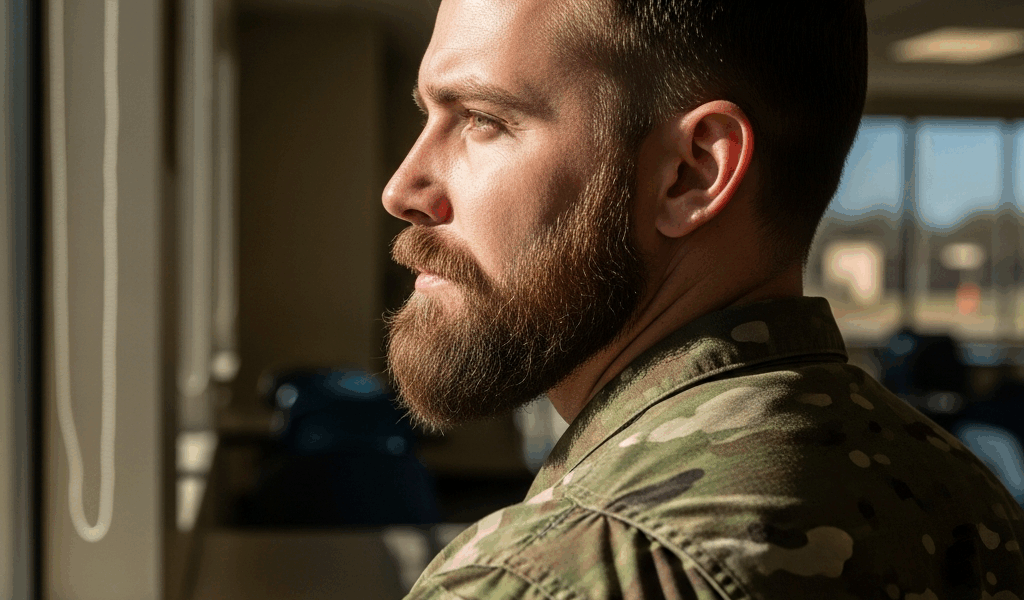
Can You Have a Beard in the Military — 2026 Rules
Can you have a beard in the military? Short answer: no. Longer answer: it depends on why you want one and which branch you’re in, and the rules shifted meaningfully in 2025 in ways that most of the existing content online hasn’t caught up to yet. I spent several weeks digging into the current DoD directives, talking to active-duty service members navigating the new waiver landscape, and cross-referencing branch-specific regulations — so what follows reflects where things actually stand heading into 2026, not where they stood three years ago.
The Short Answer — No, With Exceptions
Beards are not authorized in the United States military as a standard grooming choice. Full stop. This applies across all branches — Army, Navy, Marine Corps, Air Force, Space Force, and Coast Guard. If you’re enlisting or currently serving and you’re hoping the rules quietly changed to let you grow out a full beard, they didn’t.
Mustaches, however, are a different story. Every branch allows them, with restrictions. The mustache cannot extend below the lip line. It cannot extend beyond the corners of the mouth — so no handlebar mustaches, nothing that visually wraps around. It has to be neatly trimmed. The Army’s AR 670-1, which governs wear and appearance, is the clearest codification of this, though each branch has its own equivalent regulation with nearly identical language on facial hair.
So what are the two exceptions? Medical waivers and religious accommodations. These are not the same thing, they are not treated the same way, and — this matters — they are no longer governed by the same time limits. That distinction is where most of the confusion lives right now.
- Medical shaving waiver — Granted to service members with a diagnosed skin condition, most commonly Pseudofolliculitis Barbae (PFB), a chronic inflammatory condition disproportionately affecting Black men. Historically these waivers were relatively open-ended. That changed in 2025.
- Religious accommodation — Granted on a case-by-case basis to service members whose faith requires an uncut beard. Sikh service members are the most well-known example. These accommodations are handled differently from medical waivers and are not subject to the new 12-month limitation.
Probably should have opened with this section, honestly. It’s the frame for everything else.
Medical Shaving Waiver — The New 12-Month Limit
This is the section where 2025 actually changed something substantial. Under a DoD directive issued in late 2025, medical shaving waivers — specifically those issued for PFB and similar dermatological conditions — now carry a hard 12-month reassessment requirement. What that means in practice is that a service member on a shaving waiver must demonstrate active treatment progress within that 12-month window or face potential separation proceedings.
Before this directive, the reality on the ground was that many service members received a shaving waiver early in their career and effectively kept it indefinitely with minimal follow-up. A note in a medical file. A sympathetic corpsman or flight surgeon who renewed it during a routine physical. That pathway is now significantly narrowed.
The treatment plan requirement is the operational piece here. To maintain a medical shaving waiver past 12 months, you need documented evidence of an active, ongoing treatment protocol. This typically means one or more of the following:
- Regular dermatology appointments — at least quarterly in most cases, though some commands have interpreted this more strictly
- Evidence of prescribed treatment, which commonly includes topical retinoids, low-dose antibiotics, or laser hair removal
- A dermatologist’s written assessment of treatment progress
- Command endorsement that the waiver is medically necessary and not simply preferred
Laser hair removal has become the flashpoint issue here. Several service members I spoke with — one Army Staff Sergeant at Fort Cavazos, one Navy Petty Officer First Class stationed at Norfolk — described being told informally by medical staff that laser treatment was essentially the expected pathway to “solving” the condition rather than managing it indefinitely with a waiver. Laser hair removal costs roughly $200–$400 per session, requires multiple sessions, and is not reliably covered by TRICARE for this indication. That’s a real financial burden being placed on service members, many of them junior enlisted, and it’s generated significant frustration in the ranks.
Frustrated by the ambiguity in the new directive, one Army specialist I spoke with submitted a formal inquiry through his unit’s JAG office to clarify what “active treatment” actually required documentation-wise. He got a three-page response that, in his words, “answered nothing definitively.” That’s not unusual. The directive exists; the implementation guidance at the unit level is still catching up.
The separation risk is real. Twelve months is not a soft deadline. Service members who cannot demonstrate treatment compliance and who do not qualify for a religious accommodation face the possibility of being counseled toward separation — particularly if their condition is deemed “manageable” and they are perceived as non-compliant with treatment. This is not a common outcome yet, but it’s no longer hypothetical.
One more thing worth stating plainly: the 12-month limit does not apply to religious accommodations. If you’re considering whether your situation might qualify as a religious accommodation instead of or in addition to a medical one, that matters enormously. Keep reading.
Religious Accommodation — The Permanent Option
Religious accommodation requests for beards are handled under DoD Instruction 1300.17, which governs the accommodation of religious practices in the armed forces. The 2025 directive did not alter this framework. Religious accommodations are still evaluated case-by-case, they are not time-limited in the same way medical waivers are, and once granted, they tend to be durable.
Sikh service members have the most established precedent. The Army began granting Sikh accommodations on an individual basis starting around 2017, and the practice has solidified considerably. A turbaned, bearded Sikh soldier is now a recognizable and legally protected presence in the Army. The Marine Corps, long the strictest branch on grooming, has approved Sikh accommodations as well. These are not grudging exceptions — they’re codified through the DoDI framework.
Muslim service members have also successfully obtained beard accommodations, though the outcomes have been less uniform than Sikh cases. The key factor in Muslim accommodation requests tends to be the documentation of sincere religious belief — not orthodoxy, not community practice, but personal sincerity. The legal standard the military uses is similar to the one applied in civilian Title VII religious accommodation cases.
Other faith traditions have pursued accommodations with varying success. Norse paganism, Rastafarianism, and certain branches of Orthodox Judaism have all appeared in accommodation requests I reviewed through public records. Outcomes depend heavily on the specific command, the quality of the legal representation or chaplain support involved, and the branch.
If you’re pursuing a religious accommodation, get a chaplain involved early. This is the single most consistent piece of advice I encountered. Chaplains know the process, they can help document sincerity of belief in language the reviewing authority responds to, and they have institutional credibility that a self-written declaration doesn’t carry. Don’t skip that step.
Religious accommodations can include restrictions. Some approved accommodations specify maximum beard length — typically no more than two inches, sometimes less depending on the military occupational specialty and any safety considerations like gas mask seal. That’s a real constraint in some roles. But a two-inch beard with no time limit beats a shaving waiver with a 12-month clock.
Which Branches Are Most and Least Strict
Regulation and enforcement are not the same thing. Every branch prohibits beards. Some branches have always enforced that prohibition more loosely than others, and that’s still true heading into 2026.
The Navy and Coast Guard have historically been the most flexible, particularly in operational contexts. Sailors on extended underway periods have sometimes maintained beards informally with command tolerance, especially at the Chief Petty Officer level and above. This isn’t policy — it’s culture, and it varies enormously by command. But the baseline tolerance level for minor grooming deviations has traditionally been higher in sea-going commands than in, say, an Army infantry battalion at a major installation.
The Marine Corps is the strictest. Full stop. Marines take grooming standards more seriously institutionally than any other branch, and the enforcement is consistent rather than command-dependent. A Marine with an unauthorized beard at Camp Pendleton faces the same consequences as one at Parris Island. The culture simply doesn’t have tolerance for it the way a Coast Guard cutter might.
The Army sits in the middle, though enforcement tightened meaningfully after the 2025 directive — particularly around medical waivers, where some commands that previously renewed waivers without scrutiny are now applying the new 12-month standards more rigorously.
The Air Force and Space Force occupy a similar middle position. Both branches have leaned into a more modern, retention-focused culture in recent years, and there’s been some discussion at the policy level about whether strict beard prohibitions serve recruitment and retention goals. Nothing has changed in regulation. But the cultural pressure toward flexibility exists more visibly in those branches than in the Marine Corps.
Bottom line for 2026: can you have a beard in the military? Not without documentation — medical or religious — and if it’s medical, the clock is now ticking. Know which exception applies to your situation, build the paper trail early, and don’t assume the old informal norms still hold. The 2025 directive made sure of that.


Leave a Reply