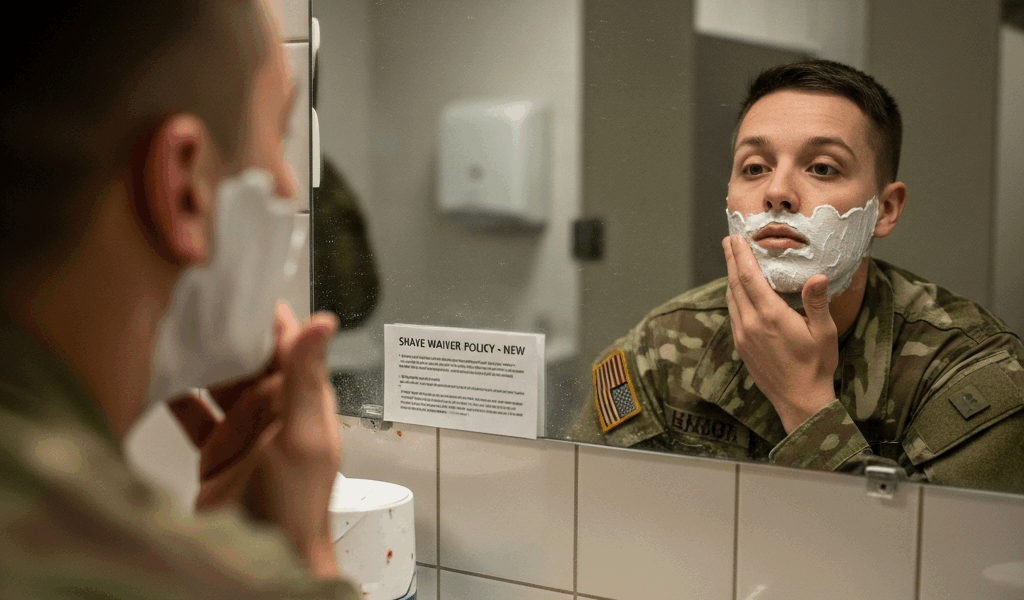
Military Shaving Waiver — New Rules and What They Mean for Your Profile
Military shaving waivers have gotten complicated with all the conflicting information flying around — Facebook groups, Reddit threads, barracks lawyers who swear they know what the new directive actually says. As someone who spent years watching fellow soldiers navigate the profile system, I learned everything there is to know about what these changes mean on the ground. Including watching a close friend lose his waiver renewal on a technicality in 2024 and scramble to avoid a flag on his record — all because nobody told him the rules had quietly shifted. So here is the clearest breakdown I can give you of what is actually changing, which branch you are in, and what you need to do before the clock runs out.
This is not a “wait and see” situation. The timeline is already running.
The Army Shaving Waiver Crackdown — What Changed
But what is the new framework, exactly? In essence, it’s the Army eliminating permanent shaving waivers entirely. But it’s much more than that — it’s a structural overhaul of how Pseudofolliculitis Barbae profiles work under AR 670-1, and it directly affects thousands of soldiers who have been carrying the same DA Form 3349 for years without incident.
Permanent shaving waivers are gone. The indefinite PFB profile has been replaced with a short-term exemption framework capped at 12 months within any rolling 24-month period. Exceed that threshold and the regulation now authorizes — not requires, but authorizes — separation proceedings based on grooming standard failure.
That sentence deserves to sit alone for a second.
Soldiers who have carried the same profile for three, five, even ten years are now operating under a policy that treats their condition as temporary. PFB is not temporary. It is a chronic skin condition. The follicles do not care what gets published in a directive — curly hair still curls back into the skin whether or not a regulation says it should stop.
Here is what the new framework looks like day-to-day. A soldier gets a short-term shaving profile — valid for 30 to 90 days, depending on the treating provider and installation policy. After it expires, back to sick call or dermatology for a renewal. Those renewals are now being counted. Hit 12 cumulative months within a rolling 24-month window and command gains the legal authority to initiate separation action. Not guaranteed. Not automatic. But authorized.
The practical problem is documentation. Most soldiers with long-term PFB profiles never tracked their cumulative days carefully — they never had to. Those profiles just rolled forward. That era is over. Soldiers need to keep personal copies of every DA Form 3349 issued, log exact start and end dates in a personal file, and run the math themselves. Don’t assume your unit S1 or your medical records system is tracking this with the precision your career now demands.
Probably should have opened with this section, honestly — because most of the social media noise around these changes fixates on the religious waiver piece, which is dramatic, sure. But the PFB changes affect a far larger population of soldiers in purely day-to-day terms.
Who Is Most at Risk
- Soldiers with existing indefinite profiles issued before the new directive — those profiles are being reviewed and reissued under the new framework right now
- Soldiers in MOSs with high operational tempo who may miss renewal windows during deployments or field exercises
- Junior enlisted soldiers who have no idea their profile now carries a cumulative clock
- Soldiers whose primary care managers rotate frequently, leaving gaps in treatment documentation continuity
The separation piece is not automatic. Commands retain discretion. But discretion is not protection — a flag on your record while separation proceedings are pending can block promotions, reenlistment, and PME attendance even if the action gets withdrawn later.
Religious Beard Waivers Are Getting Harder Too
On March 11, 2025, Secretary of Defense Pete Hegseth signed a memo that rewired the approval process and evidentiary standard for religious accommodation requests involving facial hair. Hard deadline embedded in that memo: all existing religious beard waivers must be reevaluated and either reconfirmed or revoked by June 11, 2026.
Two changes matter most — the sworn statement requirement and the elevation of approval authority.
Previously, a soldier requesting a religious accommodation submitted paperwork through their chain of command, and approval could happen at a relatively local level. Under the Hegseth memo, soldiers must now submit a sworn statement — a legally binding declaration — affirming the sincerity of their religious belief and its direct connection to the beard requirement. The memo explicitly states that false or fraudulent claims will be referred for action under the UCMJ.
That is not a vague threat. Article 107 covers false official statements — maximum punishment at a general court-martial is five years confinement, forfeiture of all pay, and a dishonorable discharge. I’m not saying every borderline claim ends in a court-martial. I’m saying the legal exposure is real, and commands have been told to treat it that way.
Approval authority has also been elevated to the service chief of personnel level — the G1 for the Army. Requests no longer stop at installation or MACOM level. They go up to a centralized decision point. The practical result is longer processing times and significantly more scrutiny. Soldiers who were approved under the old decentralized system and are now going through reevaluation should expect this process to take considerably longer than their original approval did.
What the Reevaluation Process Looks Like
Frustrated by the compressed timeline and unprepared for the documentation requirements, many soldiers with existing religious waivers are scrambling to gather paperwork they never needed before. The reevaluation is not a rubber stamp — soldiers need to provide evidence of sincere religious belief, which can include letters from a religious leader or institution, personal religious statements, records of religious practice, and the new sworn statement. Consult a JAG officer before submitting anything. That’s not overcautious — that’s basic legal hygiene when you’re signing a sworn statement with UCMJ implications attached to it.
Don’t make my friend’s mistake. If your waiver gets revoked through reevaluation, you have appeal options — but the window to use them is short. Know the timeline before you receive a revocation notice, not after.
What You Can Do If You Have a Shaving Profile
Let me talk treatment first, because the regulation change does not erase the medical reality of PFB — and there are clinical options worth knowing about.
PFB develops when curly or coarse facial hair curls back into the skin after shaving, triggering an inflammatory response. It predominantly affects Black men. The clinical management options with the strongest evidence behind them include chemical depilatories — Magic Shave powder (sodium thioglycolate, roughly $4.99 for a 4.5-ounce can at most commissaries) is the most commonly used — topical retinoids like tretinoin 0.025% or 0.05% cream, and laser hair removal.
Laser hair removal might be the best option, as long-term profile management requires demonstrated treatment engagement. That is because a soldier actively pursuing laser hair removal occupies a meaningfully different position than one who has taken no treatment steps — especially when a commander is making a judgment call about whether to initiate adverse action. Most dermatology departments at military treatment facilities offer laser hair removal, though wait times vary. At some larger posts, the wait for an initial dermatology consult is running six to eight weeks right now. That matters because of the 12-month clock. Start early, document your medical engagement, and make sure your records reflect an active treatment plan.
I learned the hard way — watching someone else’s situation, not my own — that “I have a profile” and “I have documentation of ongoing treatment” are two very different things when command starts asking questions.
Talking to Your Chain of Command
Do it before the profile expires. Not the day it expires — before. Schedule the conversation proactively, bring your current profile, bring a summary of your treatment history, and ask directly whether your command is tracking cumulative profile days. Some are. Some aren’t. You need to know which situation you are in before it becomes a problem.
Your first sergeant is your most important ally here if the relationship is solid. If it’s not, start with your platoon sergeant. Either way — don’t avoid the conversation because it feels uncomfortable. A grooming standard flag is considerably more uncomfortable than an awkward ten-minute conversation in the orderly room.
What Separation for Grooming Standards Actually Looks Like
Separation under AR 635-200 for failure to meet standards is characterized separation — not a medical discharge. It typically results in honorable or general discharge characterization depending on overall record, but it carries career implications a medical separation would not. Veterans benefits are generally not affected by honorable or general discharges, but VA healthcare eligibility and certain GI Bill provisions can be impacted by general discharges in some circumstances. Talk to a JAG attorney if you reach that point.
Branch-by-Branch Shaving Standards in 2026
The policy changes are not uniform across the services — and where you sit in the org chart matters enormously for which rules actually apply to you.
Army
The new Army directive is the most aggressive of the service changes. Permanent medical shaving waivers eliminated. Twelve-month cap in a 24-month window. Elevated approval authority for religious accommodations. All existing religious waivers reevaluated by June 11, 2026. For most soldiers this is currently the harshest environment for maintaining any form of shaving exemption across all the services.
Air Force
The Air Force published updated grooming guidance in December 2025 that brought its religious accommodation process more in line with the Hegseth memo. The Air Force previously had a more permissive framework — approvals came faster, required less documentation. The December 2025 update adds a sincerity review requirement and extends processing timelines. Critically, though, the Air Force has not eliminated medical shaving waivers the way the Army has. Airmen with PFB profiles are still on indefinite waiver frameworks at most installations — though informal guidance from several MTF dermatology departments suggests that may shift before the end of fiscal year 2026.
Navy
The Navy’s position on medical shaving waivers remains more conservative than the Army’s in terms of outright elimination. NAVADMIN guidance as of early 2026 still allows extended medical profiles for PFB with annual review — not the rolling 12-month clock the Army uses. Religious accommodation requests are subject to the Hegseth memo requirements across all services, but the medical side is handled differently here. Sailors should review their individual commands’ implementation guidance, as fleet commands retain some discretion in how they apply the annual review requirement.
Marine Corps
The Marine Corps has historically had the strictest grooming standards of any service and the narrowest interpretation of exemptions — that’s what makes the Corps’ approach endearing to Marine traditionalists, apparently, though it’s a rougher situation for Marines with PFB. Religious accommodation requests have faced the highest denial rates across the services for years. The Hegseth memo doesn’t meaningfully change the Marine Corps’ posture because that posture was already highly restrictive. Medical profiles for PFB exist but are treated as short-term by default — the Corps has functionally operated the way the Army’s new policy describes for some time already. Marines navigating PFB profiles should be working closely with their battalion medical officer and tracking documentation with extreme care.
A Note on National Guard and Reserve Components
The picture gets more complicated for Guard and Reserve soldiers — standards apply differently depending on whether a soldier is in Title 10 active duty status or Title 32 or inactive duty training status. State adjutants general retain some authority over Guard-specific policies. Reserve soldiers drilling on weekends are generally subject to the same AR 670-1 standards as active duty, but enforcement and documentation practices vary significantly by command. If you’re in the Guard or Reserve with a shaving profile, your unit S1 and your installation’s JAG office are the right starting points for clarifying exactly which version of these rules applies to your specific status.
The military shaving waiver landscape in 2026 is more complicated, more legally consequential, and moving faster than most soldiers realize. The soldiers who come out of this intact will be the ones who treat their profile paperwork with the same seriousness they treat their PT records — tracking every date, every renewal, every treatment appointment, every conversation with their chain of command. The policy changed. The skin condition didn’t. Close that gap with documentation.



Leave a Reply