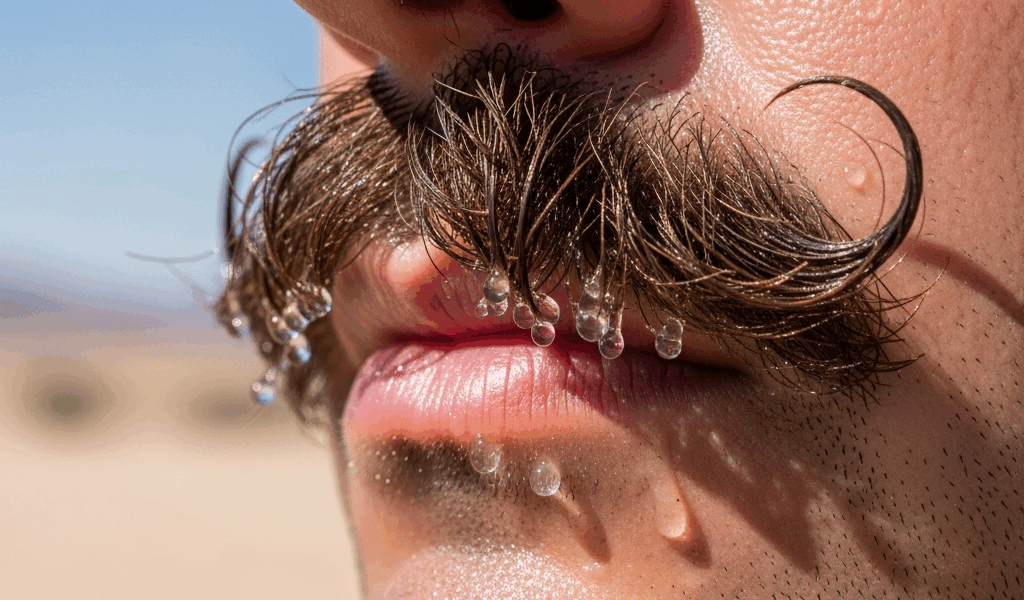
Why Mustache Wax Melts Off in the First Place
Keeping a military mustache shaped has gotten complicated with all the cheap product noise flying around. But the melting problem? Completely fixable once you know what’s actually going on.
Most affordable waxes rely on beeswax blends. Beeswax is solid for hold and texture — at least until the temperature climbs. Its melting point sits somewhere between 85°F and 90°F depending on the brand. That’s not a desert. That’s a regular summer afternoon. That’s your vehicle baking in a parking lot for 45 minutes. That’s body heat slowly working against you in a crowded barracks or a packed transport vehicle.
Once the wax softens, it loses its grip entirely. The shape you spent ten minutes on that morning starts going fuzzy. Corners flatten. Points droop. By noon you look like you styled your mustache with a hand warmer and called it a day.
The cheaper tins fail fastest. I grabbed a $3 tin once — absolute garbage in anything warmer than 75°F. The mid-range options, usually $8 to $12, hold until early afternoon if you’re lucky and conditions cooperate. But moving between air-conditioned buildings and humid outdoor heat all day? Losing that battle every single time, regardless of brand.
This isn’t a personal failing. The wax simply wasn’t engineered for those conditions.
The Wrong Wax Is Probably the Root Problem
Probably should have opened with this section, honestly. A lot of guys assume their application technique is the issue when really they’re just using a product that was never built to survive heat.
But what is a soft wax, exactly? In essence, it’s a creamy, easy-to-apply formula offering light to medium hold. But it’s much more than that — it’s also a product that breaks down the moment ambient temperature climbs past its comfort zone. Soft waxes warm up fast and feel great going on. They’re also gone by 10 AM on a hot day.
Firm and hard waxes are engineered differently. Higher ratios of petroleum-based ingredients or synthetic polymers resist heat far better than pure beeswax blends. A quality firm wax stays set around 95°F to 100°F. A hard wax can push 105°F or beyond. For military-style mustache shaping — especially those sharp corner angles that require real structural integrity — you need firmness, not creaminess. That’s what makes firm-hold wax endearing to us military guys dealing with unforgiving climates.
Heat-resistant options worth looking at include formulas built on carnauba wax, which carries a significantly higher melt point than beeswax, or blends leaning heavily on petroleum jelly and synthetic resins. Grave Before Shave’s Mustache Wax and Fisticuffs Heavy Hold show up constantly in military barbering circles. Both prioritize staying power over easy application. That tradeoff matters.
The catch: firmer waxes are harder to work with. They need more warmth to become pliable. They demand more precision. But they’ll actually stay on your mustache all day instead of sliding off around 2 PM.
How to Apply Wax So It Actually Stays
So, without further ado, let’s dive in — because technique matters even when you’ve got the right product. Bad application ruins everything.
Start with a completely dry mustache. Not mostly dry. Completely dry. Damp hair and wax together create slippage — moisture weakens the bond between wax and the hair shaft, and in heat that weakness becomes critical. Blow-dry if you need to. I’m apparently someone who sweats more than average, and skipping the blow-dry during a humid deployment cost me an entire afternoon of good shape. Don’t make my mistake.
Use less wax than you think you need. Start with a piece roughly the size of a pea — maybe smaller. More wax doesn’t mean more hold; it means more weight, and heat turns weight directly into drooping. Warm that small amount between your fingertips for 5 to 10 seconds until it’s pliable but not runny.
Here’s where most guides fail: your fingertips carry natural oils. Those oils transfer into the wax and reduce its adhesive strength. Warm the wax with your fingers, yes, but then move it onto the mustache using a small fine-tooth comb — something like a Hercules Sägemann 627 works well, about $8 online. Press the comb through the mustache, working the wax from root to tip. Even distribution, skin oils kept out of the mix. Both matter.
Shape everything exactly how you want it while the wax is still warm and workable. Then stop touching it. Let it set for a full minute — no adjusting, no fidgeting, no “just fixing the tip.” Let it firm up completely. In warm conditions this takes longer than you’d expect, so be patient.
Need extra hold on the points? Apply a second pea-sized amount using the same comb method once the first layer has fully set. Layering beats loading on one heavy glob every single time.
Quick Field Fix When It Melts Mid-Day
You’re out somewhere, the mustache is going soft, and corners are losing definition. Here’s what actually works.
Blot it first. A clean handkerchief or a dry paper towel pressed gently against the mustache will soak up the excess liquified wax and oil. Don’t scrub — just press and hold for a few seconds, then release. Removes the breakdown layer without stripping everything off.
If you’re near water — a bathroom sink, a cold wet cloth, even a water bottle — use it. Rinse just the mustache with cool water, then pat dry immediately. That re-hardens the remaining wax and washes away the dissolved portion. Takes about 30 seconds. Works better than it has any right to.
Carry a backup tin. A 0.5-ounce tin drops easily into a shirt pocket or cargo pocket. When the quick field fix isn’t cutting it, reapply a fresh layer using the comb method. Don’t try to build on top of softened existing wax — start clean. Wipe off what’s there, dry the mustache thoroughly, and apply fresh product.
That was it. No elaborate field rituals required. Prevention, quick diagnosis, fast action.
When to Switch Products Entirely
As someone who has gone through more than a dozen tins testing holds in genuinely miserable heat, I learned everything there is to know about when a product simply isn’t right for the conditions. Today, I will share it all with you — starting with the clearest signal.
If you’re reapplying every four to five hours despite solid technique, or losing shape definition in temperatures under 85°F, your current wax isn’t suited to your climate. Full stop.
Natural beeswax-heavy formulations prioritize easy application and pleasant texture over temperature resilience. Petroleum-based and synthetic waxes trade some of that texture for actual durability. In military contexts where grooming standards aren’t optional, durability wins. Every time.
A heat-resistant option might be your best move, as military mustache maintenance requires consistent hold across unpredictable conditions. That is because appearance standards don’t flex based on how warm it got outside — your product needs to handle the variance so you don’t have to think about it constantly.
Check the label or manufacturer specs for melt point ratings before buying. Anything under 90°F is risky for warm-weather use. Anything rated 95°F and above is worth a serious test run if you’re in a reliably warm environment. While you won’t need to spend $40 on specialty grooming wax, you will need a handful of firm-hold options to compare before finding the one that matches your specific climate and hair type.
I’m apparently fine-haired and Fisticuffs Heavy Hold works for me while softer beeswax formulas never last past mid-morning. Your results will vary. But your mustache shape shouldn’t depend on emergency reapplication every few hours — get a product rated for your actual conditions, apply it correctly, and cross one thing off your daily list.

Leave a Reply