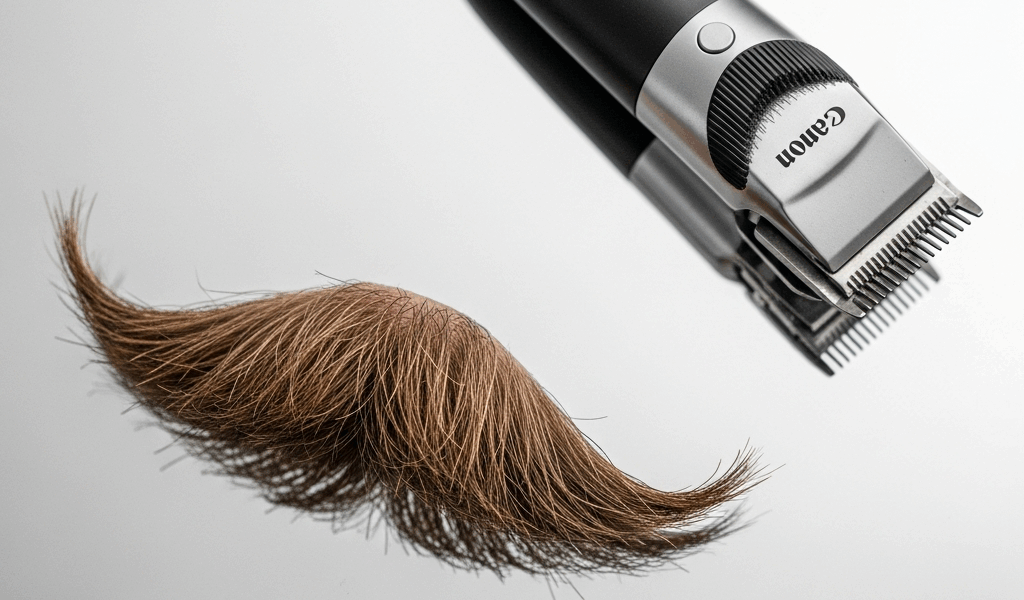
Military Mustache Too Thick in the Middle — The Specific Problem
Military mustache grooming has gotten complicated with all the conflicting advice flying around. But here’s the thing nobody talks about directly: the center bulk problem is its own beast entirely. The middle puffs out. It catches light like a ledge. It sits proud of everything around it. And you can’t just hack it down without blowing your regulation shape and spending the next week anxious about inspection.
As someone who spent three years active duty, I learned everything there is to know about this specific issue the hard way. Most barbers near base — even the ones who claim to know military regs — will either trim too conservatively and leave you lopsided, or they go aggressive and suddenly you’re below minimum length on the lip line. That “did I just fail compliance?” panic is real. Today, I will share everything that actually fixes it.
Why the Center Bulks Up More Than the Sides
The philtrum zone — that vertical groove running between your nose and upper lip — is a perfect storm of density and directional chaos. But what is the philtrum zone, really? In essence, it’s where your follicles grow in the highest concentration on your entire upper lip. But it’s much more than that.
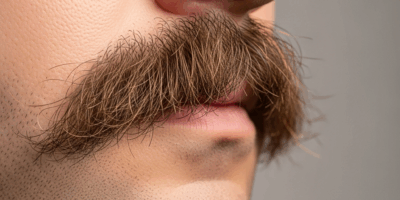
The hairs here don’t all grow straight down. Many angle sideways. Some curl slightly inward. You get compound growth patterns stacking on top of each other, and the result is a puffy, shelf-like appearance even when your sides sit perfectly flat. When you brush into regulation position, those center hairs pile onto each other. Light hits that density differently than it hits the sides.
From arm’s length, it reads as thick, uneven, non-uniform. You’re not imagining it. The problem is geometric — and it has a specific fix.
What You Need Before You Start Trimming
Probably should have opened with this section, honestly. Here’s the exact gear list:
- Adjustable-guard trimmer — the Andis T-Outliner runs about $65, the Wahl Senior around $45, either works reliably
- Fine-tooth comb — not a brush, a comb specifically
- Good overhead lighting or a ring light (this matters far more than most guys realize)
- Handheld mirror for checking side angles
- Small scissors as backup, never as primary
Trim on completely dry hair. Non-negotiable. Wet hair compresses and clings flat — it makes you underestimate exactly how much you’re removing. Dry hair shows true volume. Every hair’s actual trajectory is visible. That information is everything when you’re working the center zone.
I’m apparently someone who kept reaching for scissors early on, and the Wahl Senior works for me now while scissors never gave me the control I thought they would. Don’t make my mistake. A guard-equipped trimmer removes the guesswork entirely. You physically cannot go shorter than the guard permits. That’s the whole point.
How to Thin the Center Without Losing Length
This is the core fix. It feels counterintuitive at first — and then it works every single time.
Step One — Comb and Position
Comb your mustache downward with light pressure. Let the hair fall naturally. This is regulation position. This is the only reference point that matters here. Trim it as it actually lies, not as you fear it might look.
Step Two — Guard Selection
Start with a 1.5mm or 5mm guard. Most guys instinctively want to go shorter because the center looks thick — resist that completely. The guard is your safety wall. Start at 1.5mm if you’re uncertain. You can always go shorter next session. You cannot undo too-short. That was a lesson I relearned twice before it stuck.
Step Three — Directional Trimming
Trim across the grain in the center zone only. Not perpendicular to your lip line — that destroys the shape and creates visible gaps almost immediately. Run the guard horizontally, left to right, across the middle third of your mustache. Light passes. Two or three per side of center, never one aggressive swipe.
Across-the-grain work removes density, not length. You’re cutting the hairs standing at odd angles while leaving the dominant-growth hairs alone. Visual bulk disappears. Obvious short spots don’t appear. That’s what makes this technique endearing to us guys trying to hold regulation without looking patchy.
Step Four — Symmetry Check
Step back from the mirror. Full arm’s length. The center should sit flush with the sides now — no shelf, no proud bulge. If you still see thickness, wait 24 hours before touching it again. Sometimes an initial trim looks dramatic and then settles into proper symmetry as remaining hairs relax. Patience here saves you from over-correcting.
How to Tell If You Have Taken Off Too Much
Over-trimming shows up three ways: visible skin above the lip line where there shouldn’t be any, a noticeably shorter center compared to the sides, or a gap between hair and lip that breaks the regulation silhouette entirely.
If that happens — stop. Walk away. Do not try to fix it by trimming the sides shorter to match. Let it grow for five to seven days. Facial hair grows roughly 0.3mm per day, so a week gets you back to workable length with minimal disruption. Then reassess using a longer guard setting next time.
Wax is never a fix for length problems. Wax masks. It doesn’t solve. Save it for holding shape once the length is right, not for hiding sections you trimmed too aggressively.
Keeping the Center from Bulking Back Up
Trimmed once doesn’t mean you’re done. The center always grows back denser than the sides — always.
Maintenance runs every three to four days using the exact same technique: 1.5mm guard, light passes, across the grain. This is a micro-trim, not a full mustache session. Two minutes. That’s it. Keeps the problem from reforming before it becomes visible.
Brush daily — downward, not outward. A lot of guys brush sideways or upward thinking it creates a fuller look. What it actually does is train the hair to grow outward over time. Use a fine-tooth comb, train it downward consistently, and follow with a light wax application to hold that direction. The Layrite Matte Cream works well for this — around $15 a tin, lasts months with daily micro-use.
The goal is conditioning the hair to grow downward so the center never bulks outward in the first place. So, without further ado — prevention always beats correction, especially when regulation compliance isn’t optional.


Leave a Reply