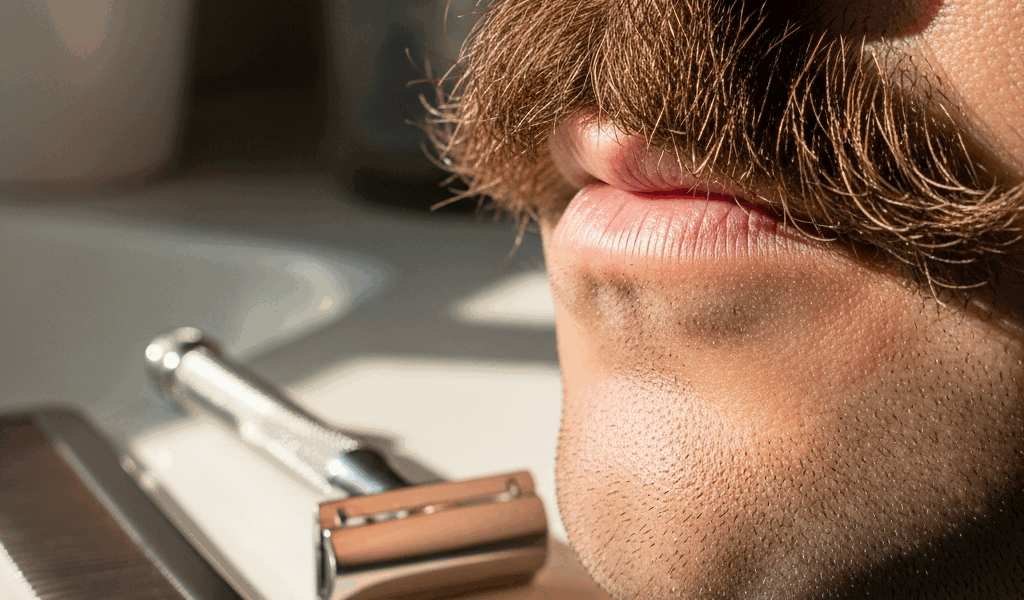
Why Shave Lines Show Up on Military Mustaches
I’ve spent enough time in the barracks and on deployment to understand why military mustache shave lines are such a persistent headache. The problem isn’t about poor technique alone—it’s about hair growth biology colliding with regulation requirements. When you shave your face clean for inspection, you’re cutting hair at skin level. But those hairs don’t all grow back at the same rate. Your mustache hair, left untouched, keeps growing at roughly 0.3 to 0.4 millimeters per day. Within 48 hours of a clean shave, you’ve got a visible demarcation line where the stubble starts. That’s the growth cycle asynchrony problem.
The real culprit is blade angle variance. Most guys shave their cheeks and neck at roughly 15 to 20 degrees to catch hair below the skin surface. But when you’re working around the mustache perimeter, you’re often changing that angle unconsciously—sometimes hitting 25 degrees, sometimes dropping to 10 degrees. Each angle cuts the hair at a slightly different depth, meaning the stubble regrowth creates an uneven visual line instead of a clean transition. Add in the fact that facial skin sensitivity varies by zone—your upper lip area has thinner, more reactive skin than your cheeks—and irritation makes the line even more pronounced. The skin reddens, the stubble catches light differently, and suddenly you look like you’ve got a racing stripe under your nose.
The Right Razor Angle and Technique to Minimize Lines
Probably should have opened with this section, honestly, because technique matters more than product choice. I made that mistake my first year—thought buying a $60 safety razor would fix everything. It didn’t, because I was still using inconsistent angles.
For mustache-specific shaving, maintain a consistent 18-degree angle with your cartridge razor or safety razor. This matters because it determines how close to the follicle you’re cutting. Too steep (25+ degrees), and you catch hair deep enough to create an extreme stubble line within hours. Too shallow (under 15 degrees), and you miss growth entirely, leaving a patchy appearance. If you’re using a multi-blade cartridge razor — like the Gillette Fusion or Schick Hydro — keep your strokes short and controlled around the mustache perimeter. Two to three passes maximum. One with the grain, one across it, one against it if needed. More passes don’t mean a closer shave; they just increase irritation and make the transition zone more visible.
Safety razors demand more precision but deliver better results for this specific problem. A vintage Merkur 34C or modern Muhle R41 cuts at roughly 18 degrees by design, removing the angle-guessing entirely. Take single-pass strokes with the grain along the shaved cheek area below the mustache, then gentle cross-grain passes only if needed. The single-blade design means you’re not dragging multiple blades through the same spot, which reduces the stubble catch that creates visible lines.
Straight razors, if you have the steadiness and time, give you maximum control. Hold it at 15 to 18 degrees and use pulling strokes rather than pushing. The full-width blade creates a uniform cut across the shaved zone, eliminating the micro-angle variations that cause line visibility. Obviously, this requires actual skill — I won’t pretend I mastered it without nicking myself repeatedly at 0400 before a formation.
Direction matters as much as angle. Always shave downward from the cheekbone toward the jaw when working the perimeter under the mustache. Shaving sideways or upward catches hair at inconsistent depths and creates that visible transition zone. Use light pressure. Pressing hard doesn’t get you closer; it just irritates the skin and makes regrowth more noticeable against the irritated background.
Timing Your Shaves to Keep Growth Even
Military schedule? That’s your friend here. Most servicemembers face inspections or photo requirements on predictable cycles — monthly PT tests, official documentation, promotion boards. Use that schedule backward. If you have an inspection on Friday morning, don’t shave Wednesday night and expect clean results Friday. The 48-hour regrowth makes visible stubble lines almost guaranteed.
Shave every 2 to 3 days instead. Seriously. This prevents the visual jump between the “just shaved” appearance and obvious stubble regrowth. After a Monday shave, by Wednesday afternoon you’ve got light stubble covering the shaved zone evenly. It’s all the same length. No line. Thursday morning you shave again, and you’re maintaining that consistency. For inspection Fridays, hit shave day Thursday evening. That gives you 12 to 14 hours of minimal regrowth before the morning formation.
The 2 to 3-day window works because it’s aligned with your actual hair growth rate. You’re removing growth before it becomes long enough to cast shadows or catch light differently. Guys who shave every 4 to 5 days create that line effect because they’re letting too much regrowth happen between passes. The stubble in the cheek area grows denser and longer than the mustache itself, creating visual contrast.
Track your shave schedule for two weeks. Note when the line becomes visible. Note when your mustache starts looking uneven, when you need that next pass. Most guys find the sweet spot is 2.5 days. Some with slower growth can push to day 3. Very few can maintain regulation appearance on a 4-day cycle without visible demarcation.
Beard Oil and Conditioner to Blend Shave Lines
Here’s what actually works for softening the visual transition. Right after shaving, your skin is irritated and slightly red. That redness sits behind the stubble regrowth, making the line more pronounced. A good beard oil or light conditioner won’t eliminate the line, but it reduces its visibility by hydrating both the skin and the emerging stubble.
Apply a lightweight beard oil — Jack Black Beard Oil works, or even basic jojoba oil — the morning after shaving. A dime-sized amount worked through the mustache and the area directly below it. This hydrates the emerging hair and keeps the skin underneath from looking inflamed. The more evenly the skin looks, the less obvious the transition line becomes. Use it before physical training or during the workday when you can’t immediately shower afterward. That’s when skin dries out and the line becomes most visible.
For the shaved cheek and neck area, a fragrance-free hydrating product works best. CeraVe Facial Moisturizing Lotion or Cetaphil applied to damp skin immediately after your morning shower locks in moisture. Dry skin under stubble makes the regrowth line stand out like a scar. Hydrated skin blends it. This matters more than most grooming advice because the effect is immediate and visible.
Timing is critical. Apply the oil or conditioner while your skin is still slightly damp from washing. It penetrates better and spreads evenly. Do it before PT if possible, before the day’s heat and activity dry everything out again.
When to Trim vs When to Shave Below the Line
Most shave-line problems come from confusion between these two operations. Trimming your mustache — cutting the hair that’s grown past regulation length — is completely different from shaving the cheek and neck area around it.
Trim the mustache itself with electric clippers. A 1/32-inch guard on a Wahl or Andis trimmer works for most regulations. Or use small scissors. This removes length without creating a regrowth line because you’re working on hair that’s already visible and established. The trim happens above the lip line, where growth is consistent and dense. No line forms because you’re not creating a zone of freshly cut stubble against uncut hair. Trimming every 5 to 7 days maintains regulation compliance without the line problem.
Shaving comes into play for the cheek and neck area below the mustache line. This is where the line develops. Regulations require clean shaving in these zones, so you have to do it. The strategy is consistency — shave every 2 to 3 days, maintain the 18-degree angle, keep the pressure light. The mustache itself stays untouched except for length trimming.
Know your regulation specifically. Some commands want the mustache edge sharp and well-defined, requiring careful shaving right up to the lip line. Others allow a softer edge. If your regulation allows a softer transition, take advantage of it. Use slightly less aggressive pressure in that exact zone, letting some stubble remain. Visually, it softens the demarcation line because there’s no stark contrast between shaved skin and stubble.
The difference boils down to this: trim the mustache on a weekly cycle, shave the perimeter on a 2 to 3-day cycle. That’s how you prevent the visible line while maintaining regulation appearance. Most shave-line problems come from guys trying to do everything at once instead of breaking it into separate maintenance schedules.



Leave a Reply