Why One Side of Your Military Mustache Grows Faster
Military mustache maintenance has gotten complicated with all the conflicting grooming advice flying around. But the uneven growth question? That one actually has a real answer — and it’s not cosmetic preference or your imagination playing tricks.
There are three concrete reasons this happens. Let’s start with the obvious one nobody wants to admit: your trimming hand is probably the culprit. If you’re right-handed, you naturally apply more pressure on your left side — the side your dominant hand reaches most comfortably. Do that enough times over six months and the difference becomes visible. I did exactly this. Spent half a year convinced my left side had some kind of follicle deficiency before realizing I’d been unconsciously over-trimming it every single session. Don’t make my mistake.
But what is follicle depth variation? In essence, it’s the biological reality that your mustache follicles aren’t planted at uniform depths across your upper lip. But it’s much more than that — one side may have deeper-rooted follicles that take longer to mature and shed, while the other cycles through growth phases noticeably faster. Some men also have significantly more active follicles on one side of the philtrum than the other. Pure biology. No technique fix required.
Sleeping position matters more than most grooming articles admit. Sleep on your right side every night and your mustache hair on that side gets compressed for six to eight hours straight. Months of that constant pressure can restrict blood flow to the follicles and actually slow growth. Sleeping on your back eliminates this entirely — which sounds like small advice until you’ve spent four weeks chasing an asymmetry problem that was your pillow’s fault.
Circulation differences round things out. Scar tissue, old injuries, or plain anatomical variation can mean one side of your face gets slightly better blood flow than the other. Better circulation equals better nutrient delivery to follicles equals faster growth. Usually minor on its own. Combined with everything else, though, it adds up fast.
How to Tell If It Is Growth or Trimming Error
Probably should have opened with this section, honestly. Before you commit to any fix, confirm you’re actually dealing with uneven growth and not just accumulated trimming mistakes — because those are two very different problems.
Stop trimming entirely for five to seven days. Not shaped, not detailed work — nothing. Let both sides grow without any intervention whatsoever. That’s your diagnostic window.
On day six or seven, photograph both sides in natural daylight. Same angle, same lighting, same distance both shots. Use your phone’s grid overlay to keep the framing consistent. This removes the whole subjective “does it look uneven to me right now” problem that gets people chasing phantom issues.
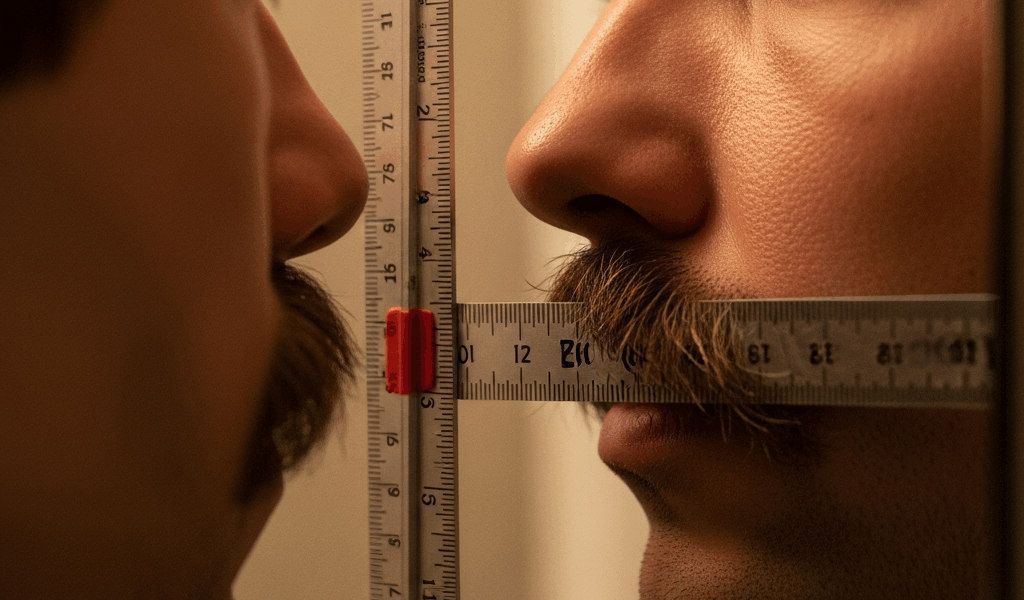
Compare the photos. Hold a ruler against the screen and measure from the lip line to the tip of the hair on each side. A quarter-inch difference is noise — ignore it. Half an inch or more indicates actual growth rate asymmetry worth addressing. Less than a quarter-inch and you’ve probably just been trimming one side harder than you realized.
Many servicemembers blame biology when the real issue is a trimming hand that drifts slightly each session, compounding into visible error over weeks. A five-day test saves you from chasing something that isn’t there. So, without further ado, let’s get into the fix.
Step-by-Step Fix for Uneven Growth Rate
Once you’ve confirmed actual uneven growth, run this protocol with consistency.
- Trim only the faster-growing side for the next two weeks. Leave the slower side completely untouched. A 0.5-inch clipper guard works well here — the Wahl Clipper Model 79300 is what I’ve been using, though honestly any guard with a fixed depth works fine. Two passes maximum on the fast side. Same angle, same pressure every time. Consistency matters more than confidence.
- Establish a philtrum anchor point. The philtrum is the vertical groove running down the center of your upper lip. Take a fine-point pen — a Staedtler 0.3mm works well — and lightly mark where your mustache should sit on both sides of that center line. This becomes your symmetry reference point. Trim parallel to these marks rather than eyeballing the whole thing freehand.
- Trim in natural light, never under bathroom vanity lights. Vanity lighting creates shadows that make one side look fuller than it actually is. Walk to a window, morning or late afternoon. The angle of natural sunlight reveals hair density differences that bathroom fixtures hide completely. That’s what makes this adjustment endearing to us grooming-obsessed types — such a small change, such a dramatic improvement in catching errors.
- After two weeks, stop and photograph again. Same process as your diagnostic photos. If the slower side has caught up, resume normal symmetric trimming. If it hasn’t, run step one for another week and retest.
- Once balanced, trim both sides to the slower side’s natural growth rate. Use that baseline going forward. This prevents the asymmetry from quietly creeping back over the following months.
Staying Within Regulation While You Fix It
The military doesn’t exactly offer grace periods for grooming corrections. Most branch regulations require mustaches ending at the corner of the lip and sitting above the upper lip line. That’s actually more room than most people think — roughly half an inch of working space between “regulation” and “out of standard.”
While you’re letting the slower side catch up, keep the faster side trimmed conservatively inside the regulation footprint. The difference between a sharp, maintained mustache and an unkempt one is about that same half-inch of length control. You can allow the slow side to grow slightly longer without violating standards — most inspectors focus on neatness above everything else.
Keep your edges clean throughout the correction phase. Sharp lines and defined edges signal control even if the overall shape is temporarily uneven. A ragged, undefined mustache looks undisciplined. A neat but slightly asymmetric one looks like someone actively managing a problem — which, frankly, it is. That’s a different thing entirely.
When the Problem Does Not Go Away
Some asymmetry is permanent. That’s just fixed biology. If you’ve run this protocol for four weeks and one side still grows measurably faster, acceptance becomes your most practical strategy.
The long-term solution is straightforward: stop trying to trim both sides equally. Consistently trim to the slower side as your permanent growth baseline. Left side grows at full speed, right side grows at 85% of that — you trim the left side down to match the right’s natural length. That becomes your standard protocol indefinitely. I’m apparently a left-faster grower and this approach works for me while symmetric trimming never did.
It’s not perfect. But it’s maintainable, regulation-compliant, and honest. You’re working with your biology instead of against it — which is, in the end, the whole point.


Leave a Reply