Why the Edges of Your Mustache Go Invisible
Military mustache upkeep has gotten complicated with all the conflicting grooming advice flying around. As someone who spent six months blaming genetics for invisible edges, I learned everything there is to know about this specific problem. Today, I will share it all with you.
The fade at your corners isn’t the same thing as having a thin mustache overall — at least not usually. Those are two different problems with two different fixes. I wasted a lot of time treating the wrong one.
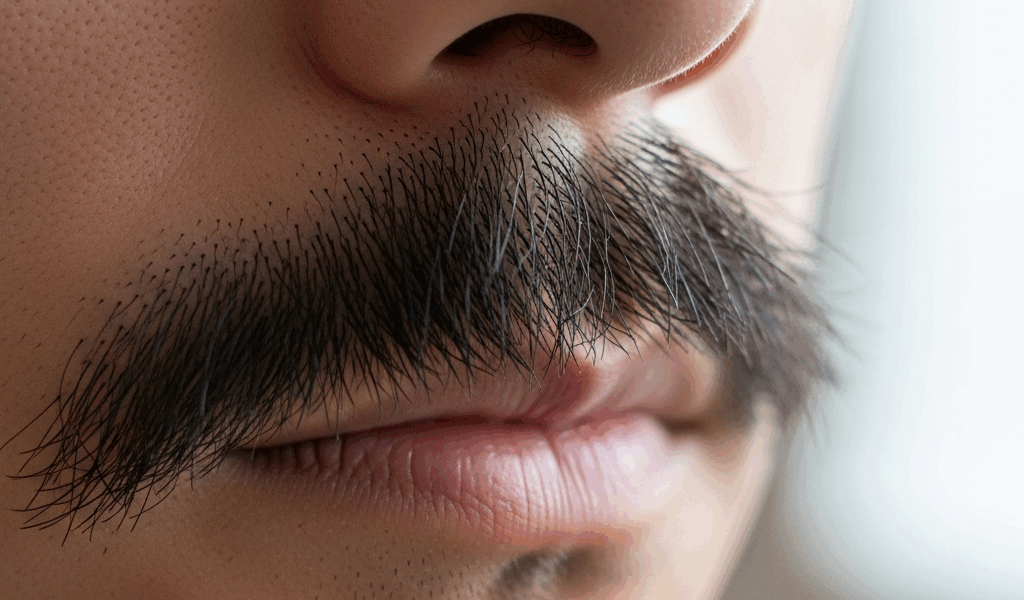
Here’s what’s actually going on. Terminal hair density — the thick, pigmented stuff that gives your mustache its actual shape — naturally drops off as it moves toward the corners of your mouth. This isn’t a defect. Most men grow facial hair this way. The hairs sitting at the outer edge are often finer, lighter, shorter than the hairs directly above your lip line. That’s just anatomy.
Warm fluorescent bathroom lighting makes those lighter hairs nearly disappear. Natural light? They might show up fine. But under artificial light during inspection, they vanish completely. That’s the fade you keep noticing.
Trimmer technique is the second cause. Running a guard too aggressively right at the corners — or angling your trimmer at a steep pitch near the edges — accidentally clips outer hairs shorter than they naturally sit. You’re not creating density. You’re removing the little that existed.
A third reason is rarer but worth checking. You might have gradually shifted your mustache boundary without realizing it, pushing the line into a zone where hair genuinely doesn’t grow thick enough to hold definition.
Check Your Trimmer Guard and Angle First
Before you blame your DNA, fix your cutting technique. This solves the problem roughly 60 percent of the time — at least if my experience with my own face counts for anything.
Most men make the exact same mistake I did. They run a trimmer with a guard — say a 5mm Wahl Senior or a 6mm Andis T-Outliner — straight across the entire mustache in one fluid motion, corners included. At the corners, the mouth curves inward. The skin contours. Running a straight trimmer perpendicular to that curve shaves those corner hairs shorter than intended. Every single time.
Don’t make my mistake.
Here’s the actual fix. Use the guard only across the center section — roughly mouth corner to mouth corner, maybe 60 percent of the total mustache width. Stop before you reach the outer edge.
Switch to scissors for the final quarter-inch on each side. Small straight scissors work better than curved here — I use a pair of Tweezerman 2.5-inch trimmers I picked up for about fourteen dollars. Hold them parallel to the hair direction, not perpendicular to your face. Trim conservatively. You’re defining the edge, not sculpting aggressively.
The guard protects the main body from harsh accidental cuts. The scissors give you angle control and real finesse at the boundary. This two-tool approach is standard in barbering. Most home-grooming guides skip it entirely, which is honestly baffling.
Do this every four or five days if your mustache grows fast. Visible difference in edge definition within two weeks. That’s what makes this method endearing to us home groomers — it’s repeatable and cheap.
What to Do If It Is a Growth Problem, Not a Trim Problem
Probably should have opened with this section, honestly.
Some men’s facial hair genuinely doesn’t grow with equal density at the corners. Genetics. Nothing wrong with it. Nothing to change about it either. If you’ve already corrected your trimmer angle and the fade keeps coming back, you’re dealing with a growth issue. Two honest options exist.
Option one: Reshape your boundary. Instead of fighting to maintain a regulation-straight line from lip center all the way to the corner of your mouth, angle the edge inward slightly. Start at full width in the center, then taper narrower as you approach each corner. This moves your visible boundary into the zone where hair actually grows thick enough to hold. It still reads military-clean. It just sits fractionally higher at the edges.
Option two: Accept a softer edge and use moustache wax. But what is moustache wax, really? In essence, it’s a firm paste that holds individual hairs in position. But it’s much more than that — at the corners specifically, a quality wax like Balm Bombay, Honest Amish, or even a basic Murray’s pomade can push lighter edge hairs outward and hold them in a position that reads defined, even when individual hairs are fine. A small amount worked into the corners with a fine-tooth comb creates visual density where actual hair density doesn’t exist. This is not cheating. This is what wax was invented for.
I’m apparently sensitive to heavier waxes and Balm Bombay works for me while Murray’s never holds past noon. Costs around eighteen dollars for a tin that lasts two months. I use maybe one-tenth of the tin on my edges each morning. Holds all day, washes out clean with hot water.
How to Define the Edge Line So It Reads Clean
A sharp, consistent edge makes even fine hairs look intentional instead of accidental. So, without further ado, let’s dive in.
Use a fine-tooth comb — not wide-tooth — and a pair of small straight scissors. Comb the mustache straight down. This shows you where hairs actually sit, not where you think they sit. Those are often different places.
Mark your boundary with a light pencil if your edges are uneven. Most men skip this step. Most men also end up with mismatched sides. The regulation line runs along the upper lip, with the lower mustache edge sitting no lower than the corners of your mouth. That’s your benchmark every time.
Trim hair by hair along that line. Sounds tedious. Takes three minutes. Worth it.
Trim in natural light — near a window or outside entirely. Warm bathroom fluorescents hide exactly the edge fading you’re trying to correct. You’ll fix something you literally cannot see, then watch the problem reappear under different lighting. Work in daylight. You’ll see what you’re actually doing for once.
Keeping the Edges Sharp Between Trims
Daily maintenance prevents backsliding — at least if you care about consistency between barbershop visits.
Comb the mustache downward every morning. This trains hairs to fall in one direction and consolidates visual thickness at the edge. Takes thirty seconds. Skipping it compounds over a week.
If you’ve gone the wax route, apply it to the corners only. Small amount on a comb. Press through the edge hairs two or three times. Done. The wax holds the outward position through a full workday without reapplication.
Touch up the edge line every four or five days with the scissors-and-comb method. Don’t wait until the mustache looks ragged. Small frequent trims maintain the line with far less total hair removal than one big correction monthly.
Realistic expectation — and this matters: if hair genuinely stops growing at a certain point, no product makes it grow further. Shape adjustment and wax handle that reality. But corrected trimmer technique and daily combing fix the visibility issue for most men. Start there first and actually see what you’re working with before assuming the worst.




Leave a Reply